2026-03-25 コロンビア大学
<関連情報>
- https://www.cuimc.columbia.edu/news/bacteria-invent-another-way-turn-genes
- https://www.nature.com/articles/s41586-026-10166-7
転用されたCRISPR–Cas12f相同遺伝子がRNA誘導型転写を促進する Exapted CRISPR–Cas12f homologues drive RNA-guided transcription
Florian T. Hoffmann,Tanner Wiegand,Adriana I. Palmieri,Juniper Glass-Klaiber,Renjian Xiao,Stephen Tang,Hoang C. Le,Chance Meers,George D. Lampe,Leifu Chang & Samuel H. Sternberg
Nature Published:04 March 2026
DOI:https://doi.org/10.1038/s41586-026-10166-7
Abstract
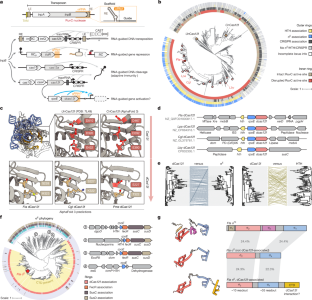
Bacterial transcription initiation is a tightly regulated process that canonically relies on sequence-specific promoter recognition by dedicated sigma (σ) factors, leading to functional DNA engagement by RNA polymerase (RNAP)1. Although the seven σ factors in Escherichia coli have been extensively characterized2, Bacteroidetes species encode dozens of specialized, extracytoplasmic function σ factors (σE) whose precise roles are unknown, pointing to additional layers of regulatory potential3. Here we uncover a mechanism of RNA-guided gene activation involving the coordinated action of σE factor in complex with nuclease-dead Cas12f (dCas12f). We screened a large set of genetically linked dCas12f and σE homologues in E. coli using RNA and chromatin immunoprecipitation experiments, revealing systems that exhibit robust guide RNA enrichment and DNA target binding with a minimal 5′-G target-adjacent motif. Recruitment of σE was dependent on dCas12f and guide RNA, suggesting direct protein–protein interactions, and co-expression experiments demonstrated that the dCas12f–gRNA–σE ternary complex was competent for programmable recruitment of the RNAP holoenzyme. Remarkably, dCas12f–RNA–σE complexes drove potent gene expression in the absence of any requisite promoter motifs, with de novo transcription start sites defined exclusively by the relative distance from the dCas12f-mediated R-loop. Our findings highlight a new paradigm of RNA-guided transcription that embodies natural features reminiscent of CRISPR activation (CRISPRa) technology4,5.