2026-05-22 弘前大学
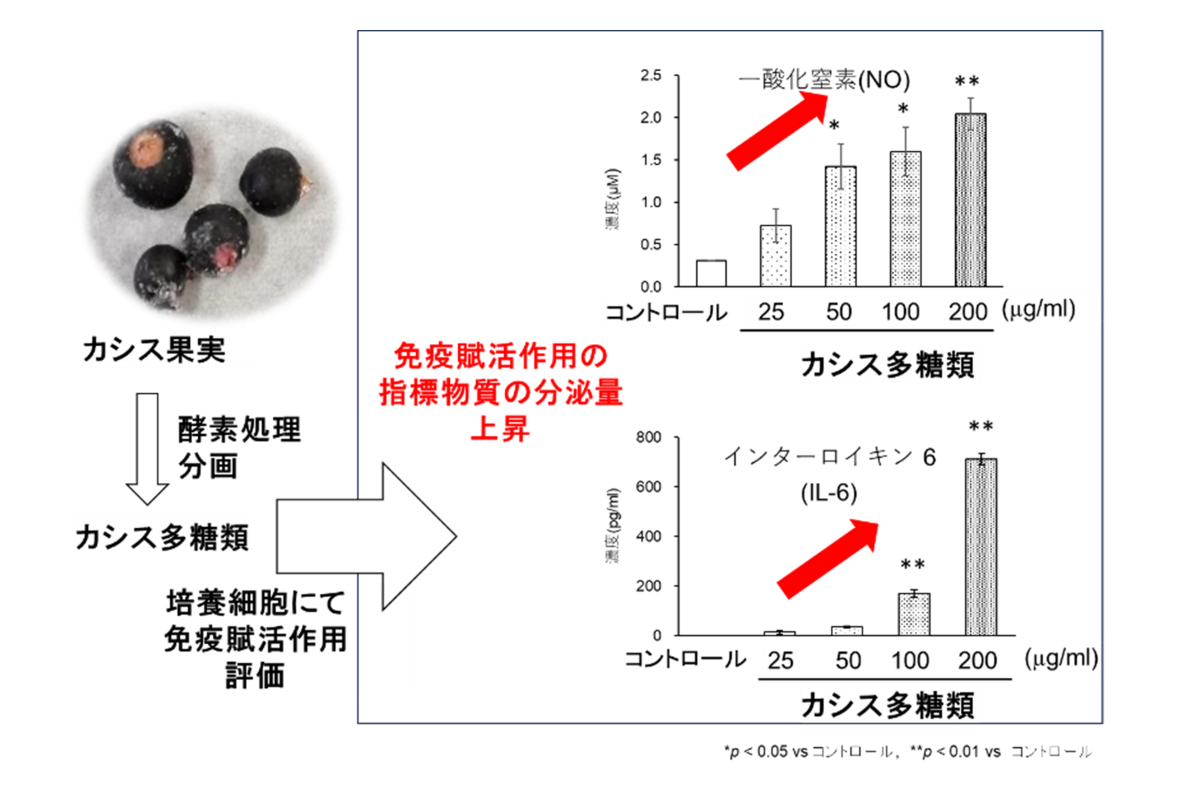
図2 カシスから調製した多糖類による免疫賦活作用の指標の上昇作用
<関連情報>
- https://www.hirosaki-u.ac.jp/topics/114035/
- https://www.jstage.jst.go.jp/article/fstr/32/2/32_FSTR-D-25-00111/_article/-char/en
マウスマクロファージ様細胞RAW264.7におけるブラックカラント多糖加水分解物の免疫刺激活性 Immunostimulatory activity of blackcurrant polysaccharide hydrolysate in mouse macrophage-like RAW264.7 cells
Hayato Maeda , Misaki Hayashi, Teruko Konishi, Nanaka Matsukawa, Momoka Tahara, Riku Daimon, Ryoji Takata, Yoji Kato
Food Science and Technology Research Published:December 10, 2025
DOI:https://doi.org/10.3136/fstr.FSTR-D-25-00111
Abstract
Blackcurrant (Ribes nigrum) fruit has been traditionally eaten in Europe and elsewhere. The polysaccharides in blackcurrant reportedly have anti-allergic and immunostimulatory effects and other functional properties, but their structure has not yet been resolved. This study investigated the immunostimulatory effects of blackcurrant polysaccharides, with the aim of identifying their active structures. Polysaccharides isolated from blackcurrant significantly up-regulated inducible nitric oxide synthase (iNOS) and interleukin (IL)-6 expression in RAW264.7 cells. Further analyses of the active fraction (Fr.) 3 revealed that it increased IL-6, tumor necrosis factor-α (TNF-α), and nitric oxide (NO) production in a dose dependent manner. The sugar composition of Fr. 3 indicated the presence of rhamnogalacturonan-I (RG-I) and xylogalacturonan (XGA), with approximate molecular weights of 5,000 Da. These findings suggest that the blackcurrant polysaccharide immunostimulatory activity is linked to this unique RG-I and XGA structure, highlighting their potential as functional food ingredients.