2026-06-09 マウントサイナイ医療システム((MSHS)
<関連情報>
- https://www.mountsinai.org/about/newsroom/2026/could-mri-predict-kidney-disease-before-it-develops-award-winning-study-suggests-new-possibilities
- https://onlinelibrary.wiley.com/doi/10.1002/jmri.70213
- https://jitc.bmj.com/content/13/12/e012833
腎腫瘤に対する腎摘出術を受ける患者における腎機能悪化および慢性腎臓病発症を予測するための多項目MRI:パイロット研究 Multiparametric MRI for Predicting Renal Function Deterioration and Chronic Kidney Disease Development in Patients Undergoing Nephrectomy for Renal Masses: A Pilot Study
Mira M. Liu, Octavia Bane, Xin Mu, Haitham Al-Mubarak, Arthi M. Reddy, Ian Bolger, Ghadi Abboud, Paul Kennedy, Philip Robson, Kirolos Meilika, Amir Horowitz, Bernd Kuhn, …
Journal of Magnetic Resonance Imaging Published: 14 January 2026
DOI:https://doi.org/10.1002/jmri.70213
ABSTRACT
Background
Patients with solid renal masses (SRMs) are at risk of chronic kidney disease (CKD) after surgical resection without a reliable pre-operative predictor.
Purpose
To investigate whether pre-operative multiparametric MRI (mpMRI) can predict CKD development and progression to stage 3 CKD.
Study Type
Prospective.
Population
Forty-three participants (female = 13, mean age: 59 ± 12 years) undergoing nephrectomy for SRM.
Field Strength/Sequence
1.5 T, diffusion-weighted echo-planar imaging (DWI) using nine b-values (0–800 s/mm2), T1-mapping using variable flip angle, multi-echo gradient-echo blood-oxygen-level-dependent (BOLD), and dynamic-contrast-enhanced MRI (DCE-MRI) using 3D T1-weighted gradient-echo.
Assessment
A clinical CKD risk score was calculated from estimated glomerular filtration rate (eGFR), age, diabetes, and surgery (partial or radical nephrectomy). mpMRI parameters included cortical and medullary apparent diffusion coefficient (ADC), intravoxel incoherent motion (IVIM), tri-exponential diffusion (fast, medium, and slow), and spectral diffusion (vascular, tubule, and tissue) from DWI, native T1 from T1-mapping, R2* from BOLD, and renal plasma flow and eGFR from DCE-MRI. Outcomes were a correlation with baseline eGFR, prediction of postoperative 12-month eGFR decline > 5 mL/min/1.73 m2, and stage 3 CKD development (eGFR < 60 mL/min/1.73 m2).
Statistical Tests
Mann–Whitney U-test and Spearman’s rank correlation coefficient (r). Diagnostic ability was determined by leave-one-out cross-validated logistic regression area-under-the-receiver-operator-curve (AUC) and diagnostic odds ratio (DOR) with p-value < 0.05 considered significant.
Results
Thirty of 43 (67%) participants had normal baseline renal function (eGFR ≥ 60 mL/min/1.73 m2). Twenty-nine participants completed 12-month follow-up: among 66% (19/29) who had baseline normal eGFR, 37% (7/19) developed stage 3 CKD. eGFR from DCE-MRI and tubule diffusion correlated with baseline eGFR ( = 0.43 and 0.33 respectively). Reduced vascular diffusion predicted eGFR decline (AUC = 0.75–0.83, DOR = 6.8–16.5). A larger contralateral ADC corticomedullary difference (AUC = 0.89; DOR = 22.5), and clinical CKD risk score (AUC = 0.81; DOR = 5.5) were the strongest predictors of CKD development.
Data Conclusion
Pre-operative mpMRI predicted post-nephrectomy CKD development. A larger corticomedullary difference in ADC may indicate reduced functional reserve.
Evidence Level
1.
Technical Efficacy
Stage 2.
Plain Language Summary
Participants with solid kidney tumors often undergo invasive surgery to remove the tumor without knowing their individual risk of developing chronic kidney disease afterwards. This study tested if multiparametric kidney MRI performed before surgery could predict decline in kidney function and progression of chronic kidney disease within a year. The results suggest that MRI provides complementary information beyond standard clinical and laboratory measures for predicting kidney disease. As new medications become available to protect kidney function, MRI combined with clinical and lab data may help guide treatment planning, monitoring, and early intervention for participants preparing to undergo kidney tumor surgery.
多パラメータMRIを用いた腎腫瘤の免疫腫瘍学的プロファイリング:パイロット研究 Immuno-oncologic profiling of renal masses using multiparametric MRI: a pilot study
Mira M Liu,Octavia Bane ,Xin Mu,Haitham Al-Mubarak,Ghadi Abboud,Arthi M Reddy,…
Journal for ImmunoTherapy of Cancer Published:5 December 2025
Abstract
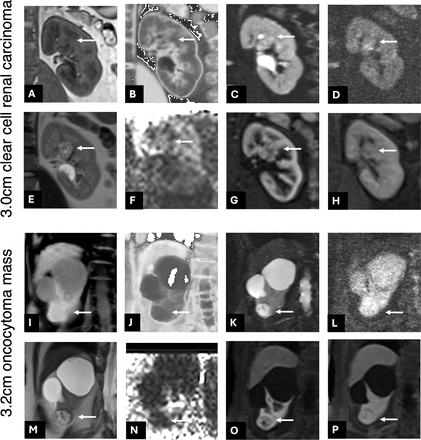
Purpose Preoperative characterization of renal mass malignancy, subtype, and immuno-oncologic pathology could inform and improve tailored management decisions. We examine multiparametric MRI (mpMRI) for (1) sensitivity to immuno-oncologic markers of the tumor immune microenvironment and (2) classification of tumor malignancy, subtype, and grade.
Methods and materials In a prospective, institutional review board-approved single-center study, 40 patients (13 female/27 males, 60.4±10.7 years) scheduled to undergo surgical management of solid renal masses underwent preoperative 1.5T MRI. This included T1, multi-b-value diffusion-weighted imaging (DWI as intravoxel incoherent motion (IVIM), and apparent diffusion coefficient (ADC)), R2*, arterial spin labeling (ASL), and dynamic contrast-enhanced (DCE-)MRI. Clear cell likelihood scores (ccLS) were assigned using clinical MR images. Tumor diagnoses were extracted from the surgical histopathology. Logistic regression models were built with leave-one-out cross-validation and bootstrapping. Interobserver measurements were obtained in a subset of 27 patients, and tests–retests were run for 2 patients. Tumors from 18 patients with clear cell renal cell carcinoma (ccRCC) underwent immunohistochemistry for CD3, CD4, CD8, CD68, PD-L1, NKp46, HIF-1α, and CD31. MR biomarkers of immunohistochemistry stains were identified with Pearson’s r correlation, and diagnostic OR for >5% or >15% cells stained positive, by cross-validated univariate logistic regression.
Results Of the 40 solid renal masses (mean (range)=32 (8–68) mm), 22 were clear cell, 9 non-clear cell and 9 benign, with 10 Grade 1. IVIM f, D*, and fD* correlated with T cells (CD4, CD3, CD8), while R2* correlated positively with macrophage presence (CD68) and negatively with angiogenesis (CD31). DCE-MRI and ASL negatively correlated with CD68. ASL negatively correlated with CD8 T cells. IVIM D* returned a significant OR for CD68-positive stains (OR=55.0, p<0.001), while ASL renal blood flow returned a significant OR for CD8-positive stains (OR=24.0, p=0.03). mpMRI tumor volume and IVIM D heterogeneity returned the highest AUC(95%CI)=0.84(0.70,0.98) ) for malignancy. ccLS had the highest AUC(95%CI)=0.75(0.56,0.92) for overall detection of ccRCC, and mpMRI distinguished ccRCC from non-ccRCC with increased IVIM D and ADC with AUC(95%CI)=0.95(0.86,1.0) .
Conclusion In this pilot study, mpMRI was sensitive to immuno-oncologic biomarkers supporting preoperative MRI as a method of characterizing tumor immune microenvironment, malignancy, and subtype for informed and tailored treatment management.