2026-07-24 国立環境研究所
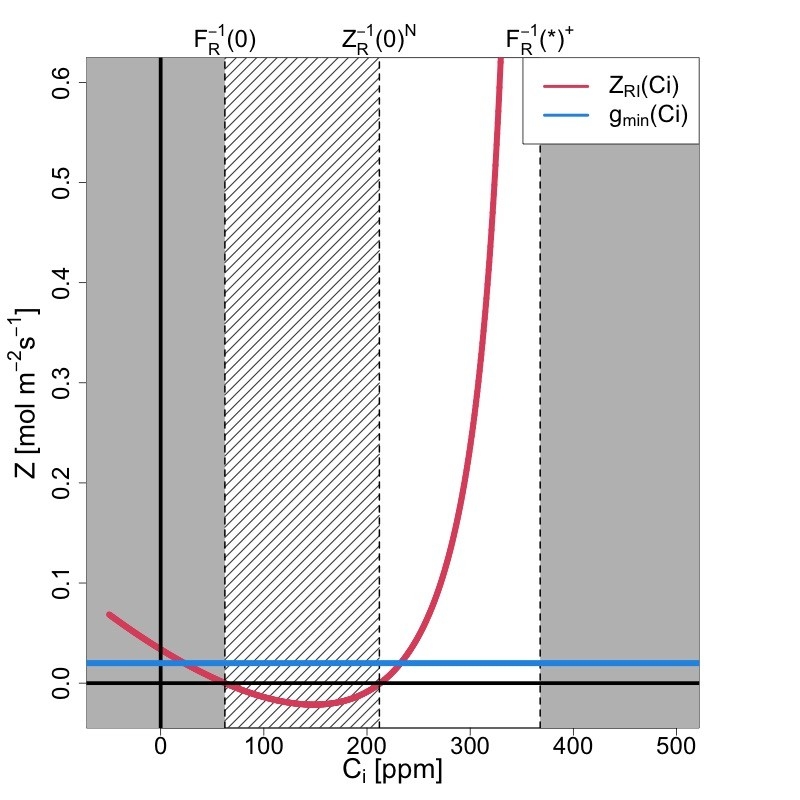
図1 標準モデルの1変数幾何学的表現
<関連情報>
- https://www.nies.go.jp/pr/news-and-updates/2026/Press20260724-2.html
- https://onlinelibrary.wiley.com/doi/10.1111/gcb.70974
C3植物の葉の光合成-蒸散-気孔コンダクタンスモデルにおける解の存在と一意性 The Existence and Uniqueness of Solutions in the Leaf Photosynthesis-Transpiration-Stomatal Conductance Model for C3 Plants
Yuji Masutomi, Kazuhiko Kobayashi
Global Change Biology Published: 24 July 2026
DOI:https://doi.org/10.1111/gcb.70974
ABSTRACT
The leaf photosynthesis–transpiration–stomatal conductance model, which consistently describes leaf photosynthesis, transpiration, and stomatal conductance, has been widely used as a standard for quantifying these processes in terrestrial plants. However, since its proposal more than 30 years ago, the model has faced a fundamental mathematical problem: Does a solution always exist? And even if a solution is obtained, can it be guaranteed to be the correct one among potentially multiple mathematical solutions—that is, the one actually realized in nature? Here, we resolve this problem by mathematically proving that the model always yields a unique solution satisfying biologically and physically meaningful criteria. This result establishes a rigorous mathematical theorem on the existence and uniqueness of solutions in the model, thereby ruling out concerns about the non-existence of solutions and ensuring that past and future estimates satisfying the criteria are correct. These findings provide a robust theoretical foundation for the model and have far-reaching implications for a broad range of fields, spanning plant and ecosystem research to climate and Earth system studies.