2026-06-10 オックスフォード大学
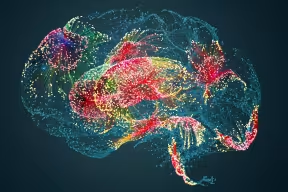
A new Oxford-led study has shed light on how vertebrates evolved the complex brains that distinguish them from other animals. Image credit: nopparit, Getty Images.
<関連情報>
- https://www.ox.ac.uk/news/2026-06-09-ancient-genome-duplications-laid-the-foundations-of-complex-brains
- https://www.nature.com/articles/s41586-026-10629-x
全ゲノム重複が脊椎動物の脳における細胞型の進化を形作った Whole-genome duplication shaped cell-type evolution in the vertebrate brain
Yuanzhen Zhu,Shuai Zhang,Jiankai Wei,Diego Dolgetta-Garcia,Katia Jindrich,Huimin Liu,Chenggang Shi,Rongrong Pan,Yuwei Chen,Yan Xu,Qiye Li,Günter P. Wagner,Peter W. H. Holland,Guang Li & Sebastian M. Shimeld
Nature Published:10 June 2026
DOI:https://doi.org/10.1038/s41586-026-10629-x
Abstract
The complex brains of vertebrates have more cell types than those of their closest relatives. Whole-genome duplications (WGDs) occurred during early vertebrate evolution1, but it is unclear whether the duplicated genes (ohnologues) facilitated cell-type evolution. Here using brain single-cell transcriptomes from five chordates—human2, mouse3, lizard4, lamprey5 and amphioxus—we report that many cell-type families with conserved core transcription factors in vertebrates do not show one-to-one homology with amphioxus. Moreover, ohnologues, particularly those from the first WGD, were more important than small-scale duplication paralogues for vertebrate cell-type evolution. To explore whether ohnologues are mechanistically important for this process, we predicted ancestral cell-type states and compared them to amphioxus and experimentally investigated macroglia. The findings indicate that ohnologues had a role in early vertebrate cell-type diversification. Moreover, by examining paralogue expression across cell types and species, we show that expression changes were mainly driven by dosage selection and subfunctionalization. We also link ohnologues to cellular diversity at different anatomical and cell-type scales. Our findings demonstrate the importance of WGDs for the evolution of early vertebrate brain complexity and highlight that the resultant ohnologues continued to capacitate cell-type evolution long after they were formed.