2026-06-10 オックスフォード大学
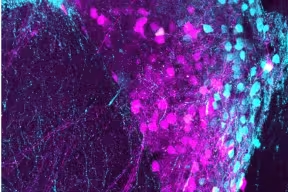
Calretinin-expressing cells in the mouse thalamus from the study (Image credit: Sara Hijazi).
<関連情報>
- https://www.ox.ac.uk/news/2026-06-10-brain-cells-critical-for-mouse-navigation-found-to-be-highly-specialised
- https://www.cell.com/current-biology/fulltext/S0960-9822(26)00631-7
マウス視床における頭部方向細胞の多様性と感覚運動特化 Diversity and sensorimotor specialization of head direction cells in the mouse thalamus
Sara Hijazi ∙ Shan Jiang ∙ Mara S. Wülfing ∙ … ∙ Patrick A. Lachance ∙ Michael E. Hasselmo ∙ Tim J. Viney
Current Biology Published:June 10, 2026
DOI:https://doi.org/10.1016/j.cub.2026.05.026
Highlights
- Calretinin distinguishes head direction cell subpopulations in the mouse thalamus
- Thalamic HD cells show distinct responses to light, sound, and movement
- Calretinin-positive cells project to deep layers of the entorhinal cortex
- HD cells are defined by combined activity, connectivity, and neurochemistry
Summary
There is increasing recognition of diversity within functionally defined classes of spatially modulated brain cells. One such functional class, the head direction (HD) cells, provides our sense of direction and is essential for spatial navigation. HD signals are routed to the cortex via the thalamus, with the highest density of HD cells found within the anterodorsal thalamic nucleus (ADn). Variability in axonal projections and in vivo firing patterns suggest the existence of distinct neuronal subpopulations in the ADn. We investigated this diversity by extracellularly recording and juxtacellularly labeling single HD cells in subregions of the ADn in awake mice. We find that in vivo firing patterns of individual HD cells are differentially modulated by light pulses, sound, and movement, indicating sensorimotor specialization. We also reveal a mediolateral gradient of calretinin (CR)-expressing (CR+) cells, with CR+ HD cells having narrower tuning widths, lower peak firing rates, and different intrinsic properties compared with CR− HD cells. We identify distinct axonal projection patterns, including HD cells innervating the thalamic reticular nucleus (TRN) and different layers of the granular retrosplenial cortex, as well as HD cells with additional collaterals in the dorsomedial striatum. We also define an unusual CR+ subpopulation, the tortuosa HD cells, which possess twisted dendrites and a descending axon that does not innervate the TRN. Together, these findings suggest that ADn HD cells comprise specific cell types that integrate multimodal streams of sensorimotor input within their receptive fields that relate to attention and arousal, thereby providing downstream targets with dynamically updated and behaviorally relevant directional information.