2026-05-20 北海道大学
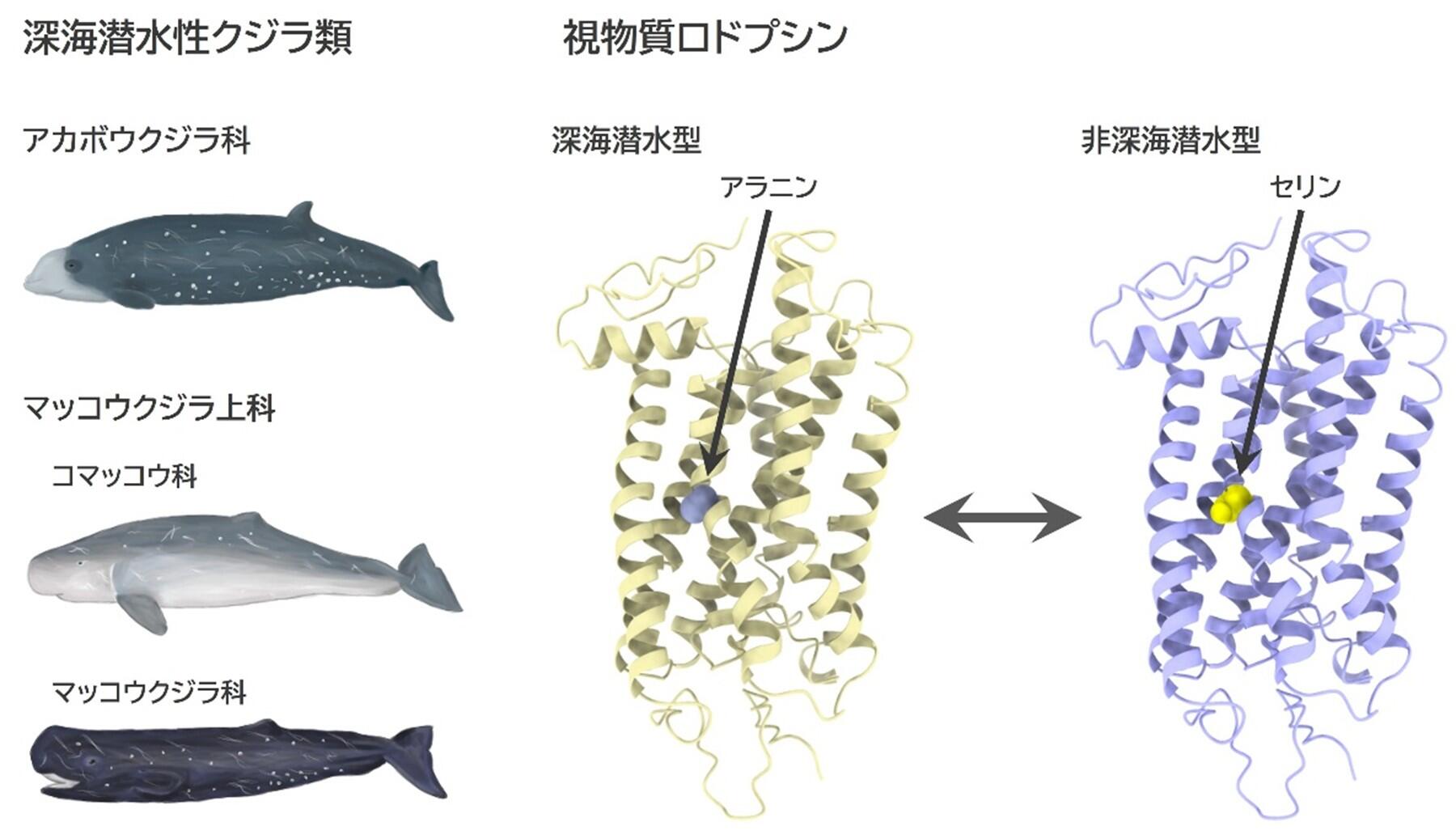
深海潜水性クジラ類(左)。視物質ロドプシンの立体構造と深海の高静水圧に適したアミノ酸(アラニンとセリン)(右)。
<関連情報>
- https://www.hokudai.ac.jp/news/2026/05/post-2289.html
- https://academic.oup.com/gbe/article/18/4/evag068/8524885
深海性クジラ類のロドプシンにおける耐圧性の進化 Pressure-tolerant Evolution in Rhodopsin of Deep-diving Whales
Hayate Takeuchi ,Takashi Hayakawa
Genome Biology and Evolution Published:16 March 2026
DOI:https://doi.org/10.1093/gbe/evag068
Abstract
Life in the deep sea presents extreme challenges to protein structure and function, with hydrostatic pressure serving as a significant source of molecular stress. Although cetacean rhodopsins have been thoroughly examined concerning their spectral tuning to the underwater light environment, their possible adaptations to pressure have yet to be explored. In this study, we investigated whether rhodopsin has undergone structural modifications that facilitate visual function during deep dives. Using a physicochemical property-based codon substitution model, we found that amino acid replacements associated with a radical shift in amino acid compressibility preferentially accumulated in deep-diving cetaceans belonging to the superfamily Physeteroidea and the family Ziphiidae. Molecular dynamics simulations further revealed that alanine at residue 2997.46a confers enhanced pressure tolerance of rhodopsin relative to serine, as evidenced by lower isothermal compressibility, diminished flexibility, and reduced free-energy costs under high pressure. These findings identify residue 2997.46a as a recurrent target for pressure adaptation in deep-diving cetaceans. More broadly, our study offers a novel perspective on cetacean visual adaptation, demonstrating that rhodopsins have evolved not only for spectral sensitivity but also for structural resilience under extreme hydrostatic pressure. This integrative framework, which combines evolutionary modeling with molecular dynamics simulations, advances our understanding of protein adaptation in the deep-sea environment.