
2026-04-01 マウントサイナイ医療システム (MSHS)
<関連情報>
- https://www.mountsinai.org/about/newsroom/2026/researchers-identify-molecular-brake-that-limits-axonal-regeneration-after-injury-to-nerves-or-spinal-cord
- https://www.nature.com/articles/s41586-026-10295-z
AhR阻害はストレス-成長スイッチを介して軸索再生を促進する AhR inhibition promotes axon regeneration via a stress–growth switch
Dalia Halawani,Yiqun Wang,Jiaxi Li,Daniel Halperin,Haofei Ni,Molly Estill,Aarthi Ramakrishnan,Li Shen,Arthur Sefiani,Cédric G. Geoffroy,Roland H. Friedel & Hongyan Zou
Nature Published:01 April 2026
DOI:https://doi.org/10.1038/s41586-026-10295-z
Abstract
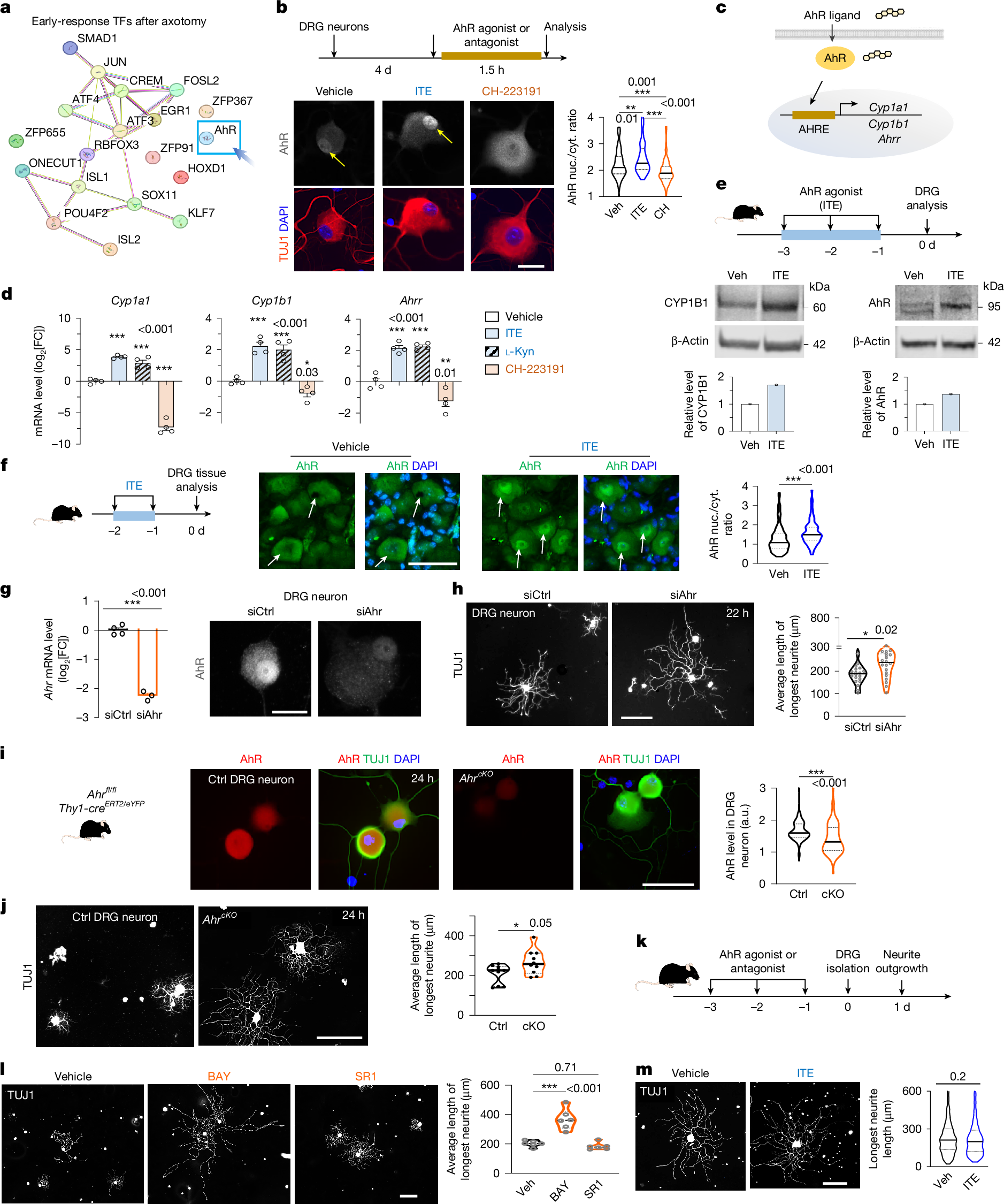
Axon regeneration is limited in the mammalian central nervous system1. Neurons must balance stress responses with regenerative demands after axonal injury2, but the mechanisms remain unclear. Here we identify aryl hydrocarbon receptor (AhR), a ligand-activated basic helix–loop–helix/PER-ARNT-SIM (bHLH-PAS) transcription factor, as a key regulator of this stress–growth switch. We show that ligand-mediated AhR signalling restrains axon growth, whereas neuronal deletion or pharmacological inhibition of AhR promotes axonal regeneration and functional recovery in both peripheral nerve and spinal cord injury models. Mechanistic studies reveal that axotomy-induced AhR activation in dorsal root ganglion neurons enforces proteostasis and stress-response programs to preserve tissue integrity. By contrast, AhR ablation redirects the neuronal response towards elevated de novo translation and pro-growth signalling, enabling axon regeneration. This growth-promoting effect requires HIF1α, with shared transcriptional targets enriched for metabolic and regenerative pathways. Single-cell and epigenomic analyses further revealed that the AhR regulon engages the integrated stress response and DNA hydroxymethylation to rewire neuronal injury-response programs. Together, our findings establish AhR as a neuronal brake on axon regeneration, integrating environmental sensing, protein homeostasis and metabolic signalling to control the balance between stress adaptation and axonal repair.

