2026-04-14 スウェーデン王立工科大学(KTH)
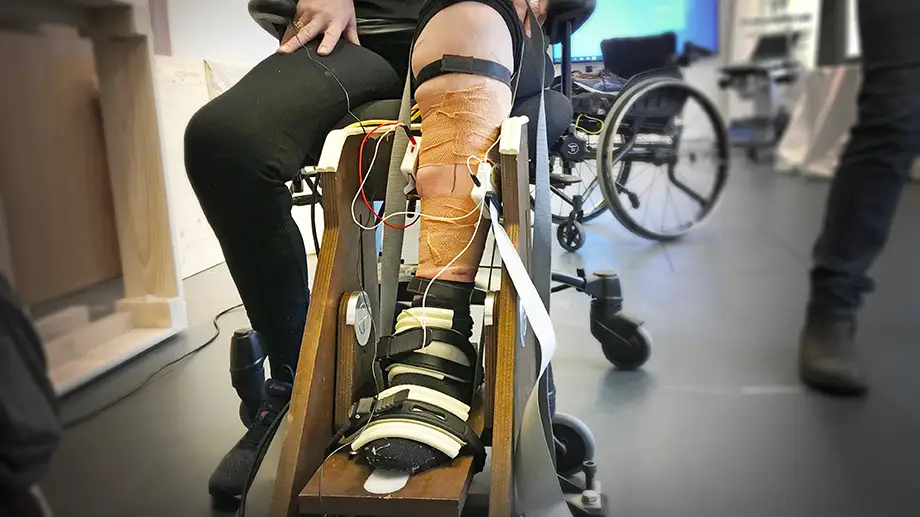
One of the study participants exerts force with their calf muscles while sensors measure electrical activity. (Photo: Ruoli Wang)
<関連情報>
- https://www.kth.se/en/om/nyheter/centrala-nyheter/study-reveals-unseen-changes-in-motor-control-after-spinal-cord-injury-1.1467973
- https://link.springer.com/article/10.1186/s12984-026-01874-2
不完全脊髄損傷のある歩行可能な患者における協調性足関節底屈筋の運動単位シナジーの適応 Adaptation of motor unit synergies in the synergetic ankle plantarflexors in ambulatory persons with incomplete spinal cord injury
Zhihao Duan,Asta Kizyte,Emelie Butler Forslund,Elena M. Gutierrez-Farewik,Pawel Herman & Ruoli Wan
Journal of NeuroEngineering and Rehabilitation Published:13 January 2026
DOI:https://doi.org/10.1186/s12984-026-01874-2
Abstract
Background
Spinal cord injury (SCI) often results in impaired motor control and coordination. Previous studies have highlighted the role of muscle synergies in coordinating motor tasks and their alterations following SCI. However, the adaptation in muscle synergy patterns at the motor unit (MU) level after SCI remains unexplored. This study aimed to investigate MU synergies and clustering in the synergetic soleus and gastrocnemius medialis (GM) muscles and to explore how these patterns are altered in persons with SCI.
Methods
High-density electromyography (HD-EMG) was used to record MU activity in the soleus and GM muscles of fifteen participants with incomplete SCI and ten non-disabled participants during 20% and 50% maximal voluntary isometric contraction tasks. The HD-EMG signals were decomposed into individual MU spike trains. Inter-muscle coherence analysis was employed to evaluate the shared neural drive between the soleus and GM muscles, and factor analysis was performed to identify synergistic clusters of MUs innervating each muscle.
Results
The results showed that both participant groups demonstrated high coherence between the soleus and GM muscles, highlighting a shared neural drive for coordinated function. However, participants with SCI showed altered coherence in the delta frequency band, with significantly higher coherence observed at 50% maximal voluntary contraction (p = 0.047). Additionally, factor analysis revealed that participants with SCI had a reduced proportion of MUs in the shared cluster within the GM muscle at 20% maximal voluntary contraction (p < 0.01).
Conclusions
These findings suggested that SCI may disrupt MU synergies and clustering, potentially impairing motor coordination. This research offered valuable insights into the underlying mechanism of muscle synergies and the neural adaptations following SCI, providing crucial information for the development of future rehabilitation strategies.