2026-04-13 ワシントン大学セントルイス校
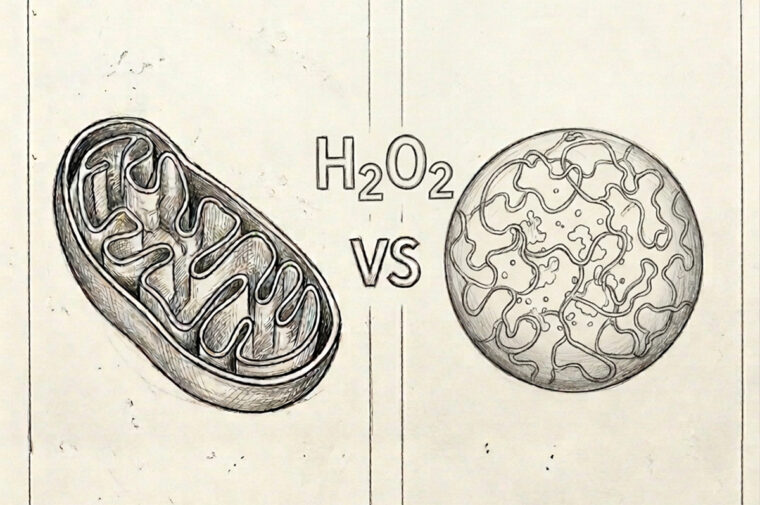
Yifan Dai and his collaborators address how biomolecular condensates create oxygen-based radicals without the presence of enzymes and uncover the chemical origins of the radical sources. Such findings provide the molecular basis for the study of the roles of condensates in cellular physiology and diseases. (Image: Dai lab, created with Google Gemini)
<関連情報>
- https://source.washu.edu/2026/04/new-research-sheds-light-on-the-path-of-neurodegenerative-diseases/
- https://engineering.washu.edu/news/2026/New-research-on-cellular-redox-reactions-sheds-light-on-the-path-to-neurodegenerative-diseases.html
- https://pubs.acs.org/doi/10.1021/jacs.6c01750
- https://pubs.acs.org/doi/10.1021/jacs.5c22593
- https://medibio.tiisys.com/110360/
生体分子凝縮体の固有の酸化還元活性の起源 Origins of the Intrinsic Redox Activity of Biomolecular Condensates
Wen Yu,Yanrun Zhou,Leshan Yang,Xiao Yan,Samuel N. Smukowski,Yuefeng Ma,Jiali Fan,Young Ah Goo,Anthony A. Hyman,and Yifan Dai
Journal of the American Chemical Society Published: March 25, 2026
DOI:https://doi.org/10.1021/jacs.6c01750
Abstract
How inherent redox activity arises in biomolecular condensates remains unclear. Unlike interfacial systems, such as water microdroplets, where water oxidation underpins redox chemistry, condensates comprise biomolecules that can potentially furnish alternative electron-transfer routes. Here, using electron paramagnetic resonance, electrochemical potentiometry, mass spectrometry, and confocal microscopy assays, we discovered that orthogonal to water oxidation, microenvironment-dependent spontaneous tyrosine oxidation encodes an alternative redox pathway. Through proton-coupled electron transfer, self-induced tyrosine autoxidation in condensates drives the formation of reactive carbon and oxygen species, providing a pathway in parallel to hydroxide oxidation for hydrogen peroxide formation in condensates. This self-induced redox pathway modulates nonequilibrium condensate behaviors, including responses to external chemical perturbations and evolution of the condensate interior microenvironment. By correlating condensate biomolecular composition with inherent redox activities, our work establishes a conceptual framework suggesting that condensate-dependent electron transfer can be critical to define the functions of condensates and deliver a new redox mechanism for cell biology.
生体分子凝縮体は、同時進行する酸化還元活性を介して窒素循環を促進する Biomolecular Condensates Power Nitrogen Cycling via Concurrent Redox Activities
Xiaowei Song,Lecheng Lyu,Chao Li,Yuefeng Ma,Yanrun Zhou,Yifan Dai,and Richard N. Zare
Journal of the American Chemical Society Published: March 4, 2026
DOI:https://doi.org/10.1021/jacs.5c22593
Abstract
The role of the inherent chemical activities of biomolecular condensates in metabolism remains underexplored. We discovered that biomolecular condensates, the constituents of which do not possess any intrinsic enzymatic activities, can modulate the nitrogen cycle composed of nitrate (NO3–), ammonia (NH3), and nitric oxide (NO·). By developing a single-condensate-based mass spectrometry technique, we observed condensate-dependent interconversion between NO3– and NH4+ with externally supplied nitrogen sources. Surprisingly, through mass-spectrometry-based protein analysis and fluorogenic reaction assays, we found that the autoxidation of the arginine residue on the disordered protein could also directly contribute to the released NO·, an important signaling factor in biological systems. This work expands our understanding about the intrinsic reactivity of biomolecular condensates, providing insight into its fundamental impact on nitrogen metabolism as a nitrogen supplier and regulator.