2026-05-15 東京科学大学
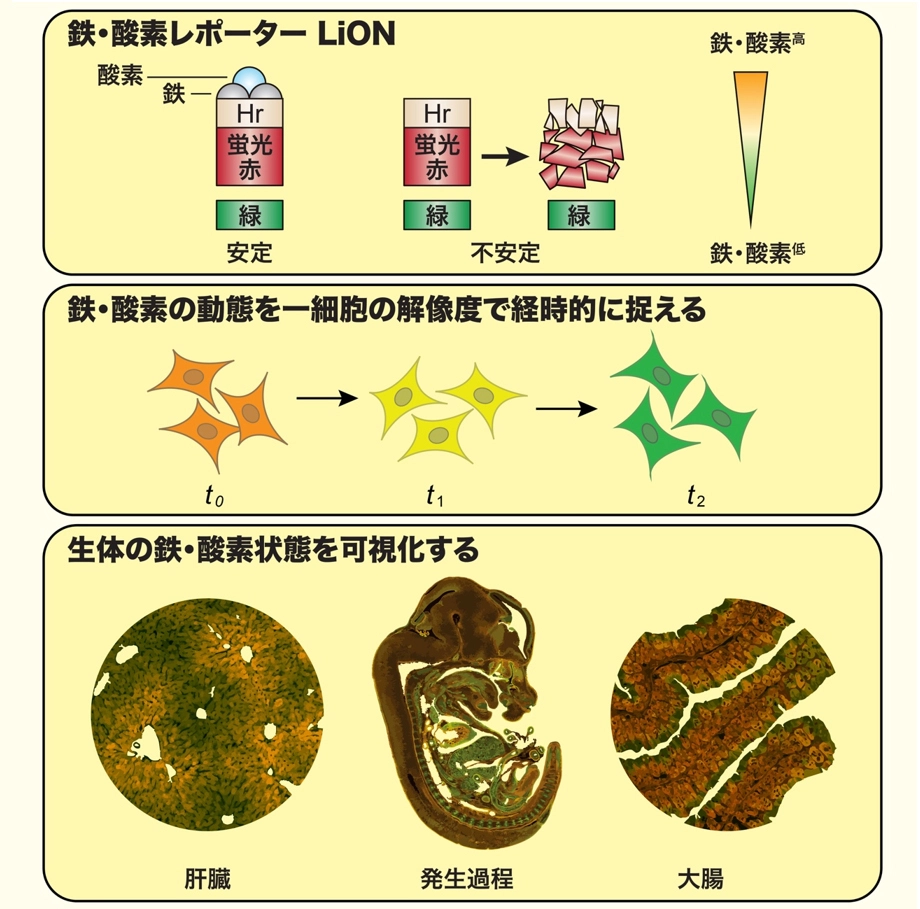
図.鉄・酸素レポーター「LiON」の仕組みと応用例(Hr:ヘムエリスリン様ドメイン)
<関連情報>
- https://www.isct.ac.jp/ja/news/5495s5ntsvvr
- https://www.cell.com/cell-reports-methods/fulltext/S2667-2375(26)00131-1
生体活性鉄と酸素の生体内可視化:不安定鉄・酸素通知剤LiONを使用 In vivo visualization of bioactive iron and oxygen using LiON, the labile iron and oxygen notifier
Ayato Maeda ∙ Akihiro Nita ∙ Shoko Sashiyama ∙ … ∙ Keiichi I. Nakayama ∙ Kimi Araki ∙ Toshiro Moroishi
Cell Reports Methods Published:May 8, 2026
DOI:https://doi.org/10.1016/j.crmeth.2026.101431
Motivation
Iron and oxygen are essential cofactors for numerous cellular processes, and their intracellular availability varies widely across tissues and cell types. Although such heterogeneity is thought to shape cellular metabolism, stress responses, and disease progression, it remains challenging to assess them in vivo. Existing methods offer important and complementary strengths; however, no current approach enables single-cell-resolved, in vivo visualization of bioactive iron and oxygen while preserving tissue architecture. To address this gap, we developed a genetically encoded fluorescent reporter that enables ratiometric imaging of intracellular labile iron and oxygen in intact tissues.
Highlights
- LiON enables ratiometric imaging of iron and oxygen in vitro and in vivo
- LiON-knockin mice enable single-cell visualization of intracellular iron and oxygen
- LiON provides a platform to study metal cofactor metabolism
Summary
Iron and oxygen are essential for numerous biological processes, yet monitoring their bioactive intracellular dynamics in vivo remains challenging due to the limitations of current detection methods. Here, we introduce the labile iron and oxygen notifier (LiON), a genetically encoded, ratiometric fluorescent reporter enabling single-cell-resolution monitoring of intracellular iron and oxygen levels in vivo. In cultured cells, LiON responds dynamically to physiologically relevant changes in iron and oxygen levels. Using LiON-knockin mice, we revealed heterogeneous distribution of iron and oxygen across tissues, cell types, and even among individual cells of the same type. Thus, LiON offers a platform for studying iron and oxygen metabolism in living organisms, providing insights into the cellular diversity of iron and oxygen utilization and their roles in physiology and disease.