2026-05-22 京都大学
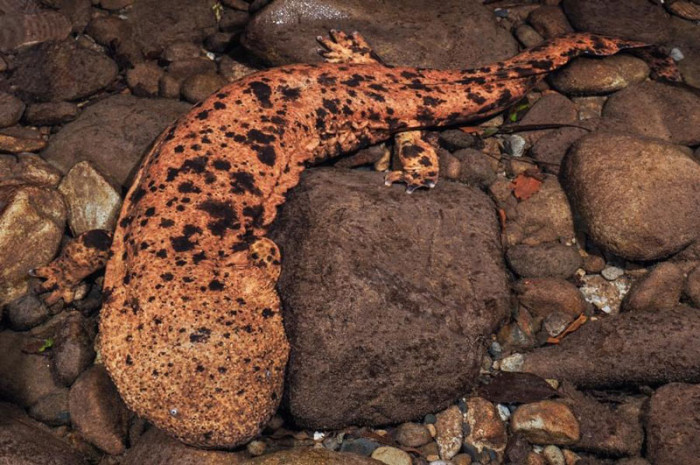
特別天然記念物に指定されているオオサンショウウオ
<関連情報>
- https://www.kyoto-u.ac.jp/ja/research-news/2026-05-22-1
- https://link.springer.com/article/10.1007/s10201-026-00844-w
オオサンショウウオ交雑個体のSSRマーカーを用いた遺伝子鑑定精度のSNP解析による再評価 Reevaluation of the genetic identification accuracy using SSR markers of giant salamander hybrids by SNP analysis
Ibuki Fukuyama,Natsuhiko Yoshikawa,Koshiro Eto,Masafumi Matsui,Atsushi Tominaga,Kazumi Fukutani,Kohei Matsubara,Sotaro Hara & Kanto Nishikawa
Limnology Published:08 May 2026
DOI:https://doi.org/10.1007/s10201-026-00844-w
Abstract
Hybridization between native and non-native species poses major conservation concerns, and rapid detection and removal of non-native and hybrid individuals in the wild is essential to preserve pure native species or populations. In Japan, hybrids between the introduced Chinese giant salamander (Andrias davidianus) and the native Japanese giant salamander (A. japonicus) have been observed, threatening the native species’ conservation. SSR markers have been used to identify hybrids between these species, but recent studies caution that SSR-based methods can underestimate hybridization and may not reflect the true genomic status. To assess SSR accuracy, we compared SSR-based assignments with genome-wide SNP data. We analyzed Andrias samples collected in Kyoto City, genotyped individuals using SNPs obtained by the MIG-seq method, and classified them as pure A. japonicus, pure A. davidianus, F1, F2, A. japonicus backcross, or A. davidianus backcross, and the result was regarded as true to evaluate the accuracy of the result based on SSR. We found that assignment accuracy for A. davidianus and hybrids generally increased with more SSR loci, but even with 14 loci, accuracy reached only about 64–78%. For binary classification of A. japonicus versus hybrids, accuracy was similar across 8–14 loci, but dropped when seven or fewer loci were used, with hybrids often misclassified as A. japonicus at five loci or fewer. We conclude that SSRs are inadequate for detailed genotype resolution, and that, even for distinguishing hybrids from A. japonicus individuals, at least eight SSR loci are advisable.