2026-07-09 カロリンスカ研究所(KI)
<関連情報>
- https://news.ki.se/simple-tools-accurate-in-predicting-older-adults-health
- https://link.springer.com/article/10.1186/s12916-026-05008-2
高齢者の健康状態の悪化を予測するための老年医学的評価ツールの比較 Comparing geriatric assessment tools for predicting negative health outcomes in older adults
Ahmad Abbadi,Francesco Innocenti,Giorgi Beridze,Emmanouil Kokoroskos,Alberto Zucchelli,Tobias Nordström,Caroline Wachtler,Laura Fratiglioni,Davide L. Vetrano & Amaia Calderón-Larrañaga
BMC Medicine Published:09 July 2026
DOI:https://doi.org/10.1186/s12916-026-05008-2
Abstract
Background
Amid global population aging, evidence-based geriatric assessment tools are essential for clinical decision-making and risk stratification. Despite growing interest, few studies have comprehensively compared the discriminative ability of existing tools, particularly as new tools have recently become available. In this study, we aimed to perform such a comparison across a wide range of patient-relevant health outcomes.
Methods
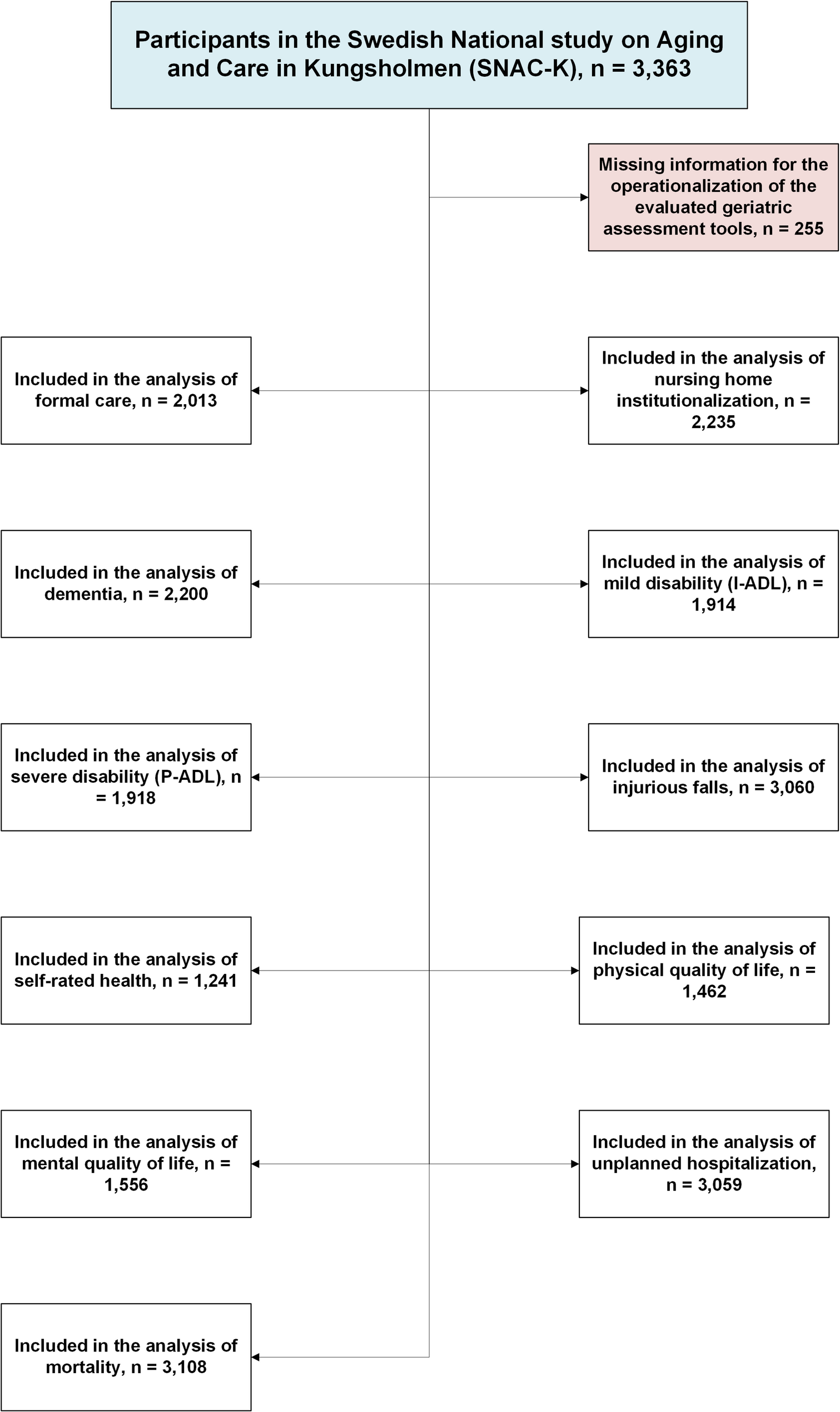
This population-based prospective cohort study used data from the Swedish National study on Aging and Care in Kungsholmen (SNAC-K). We included 3,108 adults aged ≥ 60 years at baseline (2001–2004), who were followed up for up to six years. Seven tools (Health Assessment Tool [HAT], SNAC-K Frailty Index (FI) [SNACK-FI], Primary Care FI [PC-FI], Intrinsic Capacity [IC], Geriatric 8 [G8], Charlson Comorbidity Index [CCI], and Cumulative Illness Rating Scale [CIRS]) were evaluated in terms of their discriminative ability for formal care use, institutionalization, dementia, disability, injurious falls, self-rated health, quality of life, unplanned hospitalization, and mortality, using Harrell’s C-index estimated from unadjusted cause-specific Cox models.
Results
HAT, IC, and SNACK-FI consistently ranked among the top three performers across all outcomes. The highest C-indices were observed for institutionalization (HAT 0.93 [0.91, 0.95], IC 0.93 [0.90, 0.94], SNACK-FI 0.92 [0.89, 0.94]); 1-year mortality (HAT 0.88 [0.85, 0.91], SNACK-FI 0.87 [0.84, 0.91], IC 0.86 [0.82, 0.89]); dementia (HAT 0.87 [0.85, 0.89], IC 0.88 [0.86, 0.90], SNACK-FI 0.86 [0.83, 0.88]); and formal care use (HAT 0.83 [0.81, 0.86], IC 0.85 [0.83, 0.88], SNACK-FI 0.80 [0.77, 0.83]). Tools incorporating physical function metrics (e.g., gait speed) showed higher discriminative ability than those that omitted them. IC and SNACK-FI showed marginal and clinically negligible occasional gains over HAT ( ≤ 0.02 differences in C-index), despite greater complexity and a larger number of indicators. Guideline-endorsed tools (e.g., G8, CCI, CIRS) showed comparatively lower discrimination across outcomes.
Conclusions
Contemporary geriatric assessment tools show promise. Tools incorporating physical function metrics demonstrated superior discriminative ability, suggesting these measures may be integral to geriatric prognosis and risk stratification. Given the underperformance of several established tools, reappraisal of current guideline recommendations may be warranted.