2026-09-23 ペンシルベニア州立大学(Penn State)
<関連情報>
- https://www.psu.edu/news/agricultural-sciences/story/liver-gut-bacteria-alter-food-molecules-influence-bodys-biological
- https://www.nature.com/articles/s42003-026-10831-7
- https://medibio.tiisys.com/109217/
インドール-3-カルボン酸グリシン抱合体はアリール炭化水素受容体リガンドである Glycine conjugates of indole-3-carboxylates are aryl hydrocarbon receptor ligands
Ethan W. Morgan, Andrew J. Annalora, Denise M. Coslo, Krishne Gowda, Dhimant Desai, Fangcong Dong, Ethan H. Davis, Iain A. Murray, Fuhua Hao, Imhoi Koo, Kristina S. Petersen, Penny M. Kris-Etherton, Trenton Wolfe, Reece Erickson, Seth T. Walk, Jordan E. Bisanz, Shantu G. Amin, Craig B. Marcus, Andrew D. Patterson & Gary H. Perdew
Communications Biology Published:15 September 2026
DOI:https://doi.org/10.1038/s42003-026-10831-7 Early provide
Abstract
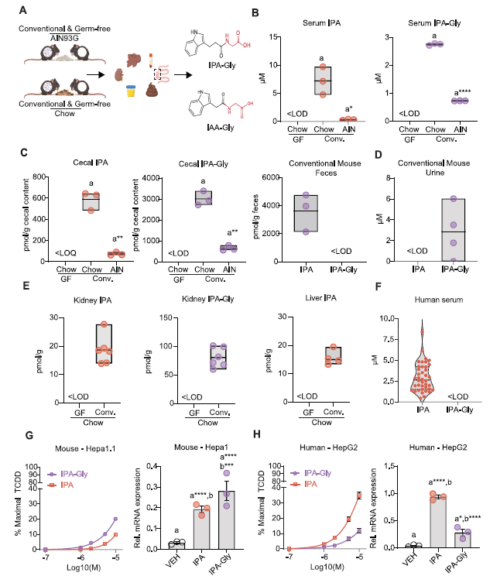
Substituted indoles are conserved metabolites across all kingdoms of life and may function as a mediators of inter- and intra-species communication. Indole-3-carboxylates (indole-3-acetic acid (IAA) and indole-3-propionic acid (IPA)) represent abundant tryptophan-derived aryl hydrocarbon receptor (AHR) agonists in human serum, potentially influencing AHR-dependent physiology. LC-MS analysis of mouse serum, urine and cecal/fecal contents reveals that both IAA and IPA undergo host and microbial mediated glycine conjugation to facilitate urinary elimination. Notably, at physiologically detectable human serum concentrations (μM), IAA-Glycine retains human AHR activation potential. Comparative in silico docking simulations corroborate IAA-Glycine as a direct ligand for the human AHR. In contrast to xenobiotic ligands such as TCDD and FICZ, the endogenous tryptophan metabolites examined here exhibited greater activation associated with human AHR relative to mouse AHR. These results underscore the role of microbial and host-derived amino acid conjugation in generating bioactive metabolites and position auxin chemistry within human physiology.