2026-09-30 マウントサイナイ医療システム(MSHS)
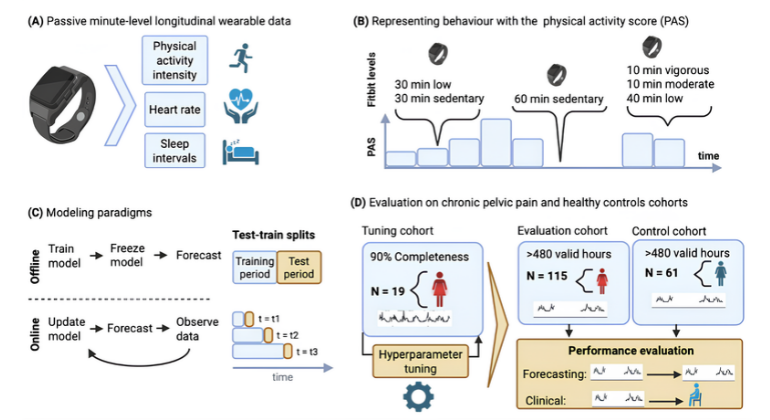
The illustration shows how the study used wearable data to forecast prolonged sedentary periods and inform future personalized movement reminders. Credit: Jegminat et al., npj Women’s Health
<関連情報>
- https://www.mountsinai.org/about/newsroom/2026/wearable-ai-forecasts-prolonged-sitting-in-women-with-chronic-pelvic-pain
- https://www.nature.com/articles/s44294-026-00156-5
慢性骨盤痛疾患における座りがちな行動の堅牢な予測:デバイス上での学習とリアルタイム展開 Robust forecasting of sedentary bouts in chronic pelvic pain disorders for on-device learning and real-time deployment
Jannes Jegminat, Samia Shahnawaz, Jovita Rodrigues, Matteo Danieletto, Kyle Landell, Gabriele Campanella, Carol Ewing Garber, Zahi A. Fayad & Ipek Ensari
npj Women’s Health Published:30 September 2026
DOI:https://doi.org/10.1038/s44294-026-00156-5
Abstract
Reducing sedentary behavior through personalized digital interventions holds particular promise for individuals with chronic pelvic pain disorders (CPPDs), who face unique barriers to physical activity. We present a self-contained, missing data-resilient framework for real-time forecasting of a physical activity score (PAS) using wearable Fitbit data from 134 females with CPPDs. Comparing online and offline learning approaches, we demonstrate that models leveraging recent activity and daily recurring patterns perform the best. When applied to 15-min sedentary bouts (SBs), the PAS forecasts support timely alerts, yielding approximately one true alert per day vs 0.6 false alerts at a conservative operating point. By integrating real-time imputation, the system supports forecasting of SBs for potential use in just-in-time adaptive interventions. Our work demonstrates a privacy-preserving, scalable pathway for integrating precision forecasting into just-in-time adaptive interventions, laying the groundwork for more equitable and effective digital health solutions for women with CPPDs.