2026-10-01 ローレンス・バークレー国立研究所(LBNL)
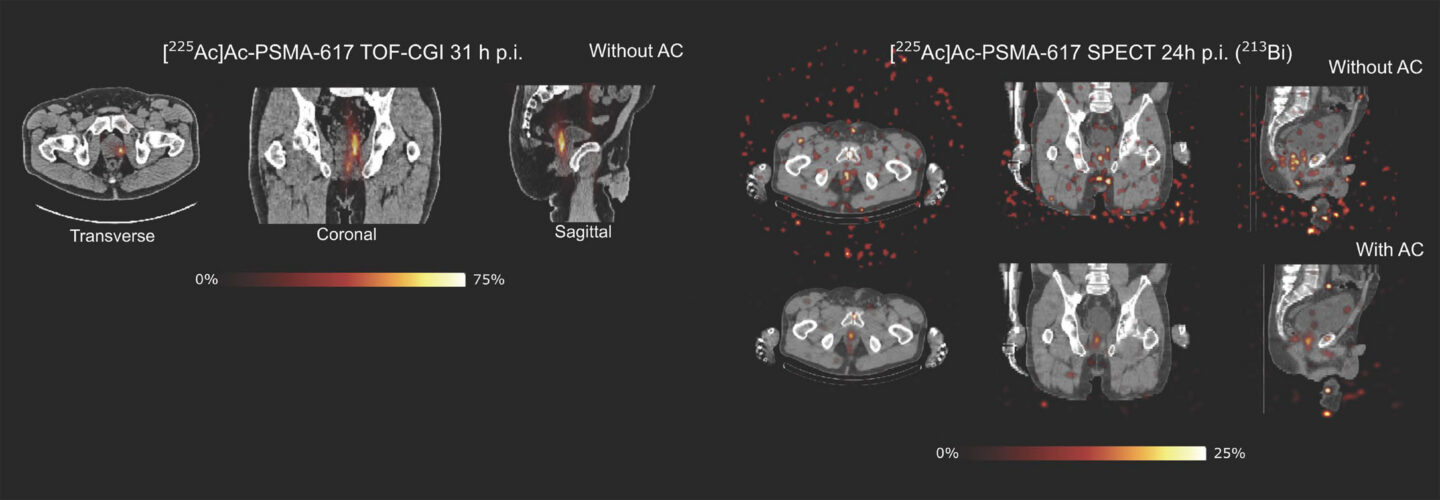
Patient images of actinium-225 PSMA-617, an experimental radioisotope, from TOF-CGI computed tomography without signal correction (at left) and SPECT with and without signal correction (at right). (Credit: Caravaca et al., Journal of Nuclear Medicine, 2026)
<関連情報>
- https://newscenter.lbl.gov/2026/10/01/targeted-cancer-therapy-gets-a-sharper-focus/
- https://jnm.snmjournals.org/content/early/2026/09/30/jnumed.126.272594
飛行時間カスケードγ線イメージングによるPETスキャナーでの225Acの臨床画像診断 Clinical Imaging of 225Ac in a PET Scanner via Time-of-Flight Cascade γ-Ray Imaging
Javier Caravaca, Youngho Seo, Jorge Cabello, Stefan B. Siegel, Robert R. Flavell and Thomas A. Hope
Journal of Nuclear Medicine Published:September 30, 2026.
DOI: https://doi.org/10.2967/jnumed.126.272594
Abstract
Clinical imaging of the α-therapy radionuclide 225Ac and its progeny has proven challenging with SPECT because of low detection efficiency and a poor signal-to-noise ratio (SNR). We propose an alternative nuclear imaging modality that enables imaging of 225Ac in PET scanners: time-of-flight cascade γ-ray imaging (TOF-CGI). Methods: We leveraged the time and position information of the γ-rays emitted in a fast cascade during the decay of 225Ac daughter 209Tl to produce 3-dimensional images of the spatial distribution of the emissions. We characterized this imaging modality with vials, evaluated it with clinical-size phantoms, and performed a pilot imaging experiment with a patient with prostate cancer injected with [225Ac]Ac-PSMA-617. Results: Imaging of vials confirmed good activity quantification linearity, minimum detectable activity of 5.5 kBq for a 20-min scan, and a spatial resolution of approximately 20 mm full width at half maximum transversally and 42 mm full width at half maximum axially. A phantom filled with a concentration of 44 kBq/mL revealed a higher SNR than did SPECT with a 10-fold-shorter scan time. The TOF-CGI sensitivity with the phantom was 26.0 cps/MBq, and the detection efficiency was an order of magnitude higher with TOF-CGI than with SPECT. TOF-CGI of the patient demonstrated activity within a known tumor in the prostate bed and higher SNR than that of SPECT. Conclusion: We demonstrated the feasibility of 225Ac tomography in a PET scanner via TOF-CGI, opening a window for application in other targeted radionuclide therapies. This technique enables imaging of nonpositron emitters in PET scanners and establishes an imaging paradigm complementary to SPECT. Implementation of image corrections and usage of long–axial-field-of-view PET scanners may further improve its sensitivity, resolution, and SNR.