2025-01-13 ノースカロライナ州立大学(NCState)
<関連情報>
- https://news.ncsu.edu/2025/01/chornobyl-dogs-genetic-differences-not-due-to-mutation/
- https://journals.plos.org/plosone/article?id=10.1371/journal.pone.0315244
- https://parasitesandvectors.biomedcentral.com/articles/10.1186/s13071-024-06563-4
突然変異の増加がチョルノブイリ立入禁止区域内の犬の遺伝的多様性をもたらしているのだろうか? Is increased mutation driving genetic diversity in dogs within the Chornobyl exclusion zone?
Megan N. Dillon,Allison N. Dickey,Reade B. Roberts,Jennifer A. Betz,Timothy A. Mousseau,Norman J. Kleiman,Matthew Breen
PLOS ONE Published: December 27, 2024
DOI:https://doi.org/10.1371/journal.pone.0315244
Abstract
Environmental contamination can have lasting impacts on surrounding communities, though the long-term impacts can be difficult to ascertain. The disaster at the Chornobyl Nuclear Power Plant in 1986 and subsequent remediation efforts resulted in contamination of the local environment with radioactive material, heavy metals, and additional environmental toxicants. Many of these are mutagenic in nature, and the full effect of these exposures on local flora and fauna has yet to be understood. Several hundred free-roaming dogs occupy the contaminated area surrounding the Chornobyl Nuclear Power Plant, and previous studies have highlighted a striking level of genetic differentiation between two geographically close populations of these dogs. With this work, we investigate mutation as a possible driver of this genetic differentiation. First, we consider large-scale mutation by assessing the karyotypic architecture of these dogs. We then search for evidence of mutation through short tandem repeat/microsatellite diversity analyses and by calculating the proportion of recently derived alleles in individuals in both populations. Through these analyses, we do not find evidence of differential mutation accumulation for these populations. Thus, we find no evidence that an increased mutation rate is driving the genetic differentiation between these two Chornobyl populations. The dog populations at Chornobyl present a unique opportunity for studying the genetic effects of the long-term exposures they have encountered, and this study expands and builds on previous work done in the area.
チョルノブイリにおけるマダニ集団とイヌ集団の病原体有病率の対比 Contrasting pathogen prevalence between tick and dog populations at Chornobyl
Megan N. Dillon,Barbara A. Qurollo,Rachael Thomas,Madeline E. Warren,Timothy A. Mousseau,Jennifer A. Betz,Norman J. Kleiman & Matthew Breen
Parasites & Vectors Published:17 November 2024
DOI:https://doi.org/10.1186/s13071-024-06563-4
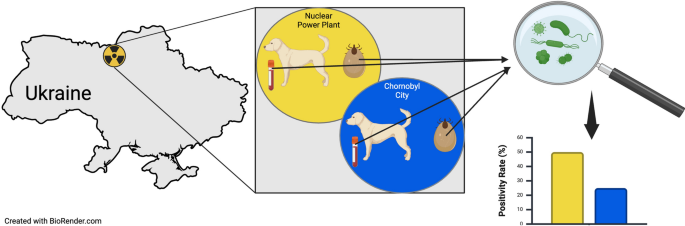
Graphical Abstract
Abstract
Background
The 1986 disaster at the Chornobyl Nuclear Power Plant released massive amounts of radioactive material into the local environment. In addition to radiation, remediation efforts and abandonment of military-industrial complexes contributed to contamination with heavy metals, organics, pesticides and other toxic chemicals. Numerous studies have evaluated the effects of this contamination on the local ecology. However, few studies have reported the effect of this contamination on vector-borne pathogens and their hosts. In this manuscript, we characterize tick-borne pathogen presence at two sample locations within the Chornobyl Exclusion Zone, one at the Nuclear Power Plant (NPP) and another 16 km away in Chornobyl City (CC).
Methods
Ticks and whole-blood samples were collected from free-breeding dogs captured at the NPP and CC. Endpoint PCR and quantitative PCR were used to identify tick species and to assess the presence of specific tick-borne pathogens, including Anaplasma phagocytophilum, Borrelia burgdorferi sensu lato, Babesia spp., Bartonella spp., Francisella tularensis and general Anaplasmataceae. A droplet digital PCR assay was developed for Babesia canis and A. phagocytophilum to evaluate their presence in dogs from the two populations. Pathogen prevalences between the two sample populations were compared by calculating Z-scores.
Results
Ticks were identified as Ixodes ricinus (n = 102) and Dermacentor reticulatus (n = 4). Overall, 56.9% of I. ricinus ticks were positive for at least one pathogen. A significantly higher prevalence of A. phagocytophilum and B. burgdorferi was found in ticks at the NPP (44.0% and 42.0%, respectively) compared to CC (23.1% and 19.2%, respectively). Babesia spp. (including B. canis and B. caballi) were detected in 8.8% ticks at similar proportions for both populations. Interestingly, we found a significantly lower level of A. phagocytophilum in dogs at the NPP (1.8%) than in dogs at CC (11.7%). In total, 24.3% of dogs were positive for B. canis, evenly distributed across the two populations.
Conclusions
The results of this study show contrasting pathogen prevalence in both ticks and dogs at the NPP and CC, which may reflect the differential exposures at the two locations. This work adds an important new component to our understanding of the consequences of prolonged exposure to environmental contamination on the wildlife and ecology within the Chornobyl Exclusion Zone.