2025-07-09 東京大学
 葉の尾状先端の発生仕組みの解明
<関連情報>
二領域分化成長により葉に鋭い頂点と凹状の接合部が生じる Biregionally differentiated growth generates sharp apex and concave joints in leaves
Zining Wang, Yasuhiro Inoue, Atsushi Mochizuki, Hirokazu Tsukaya
The Plant Journal Published: 05 July 2025
DOi:https://doi.org/10.1111/tpj.70310
SUMMARY
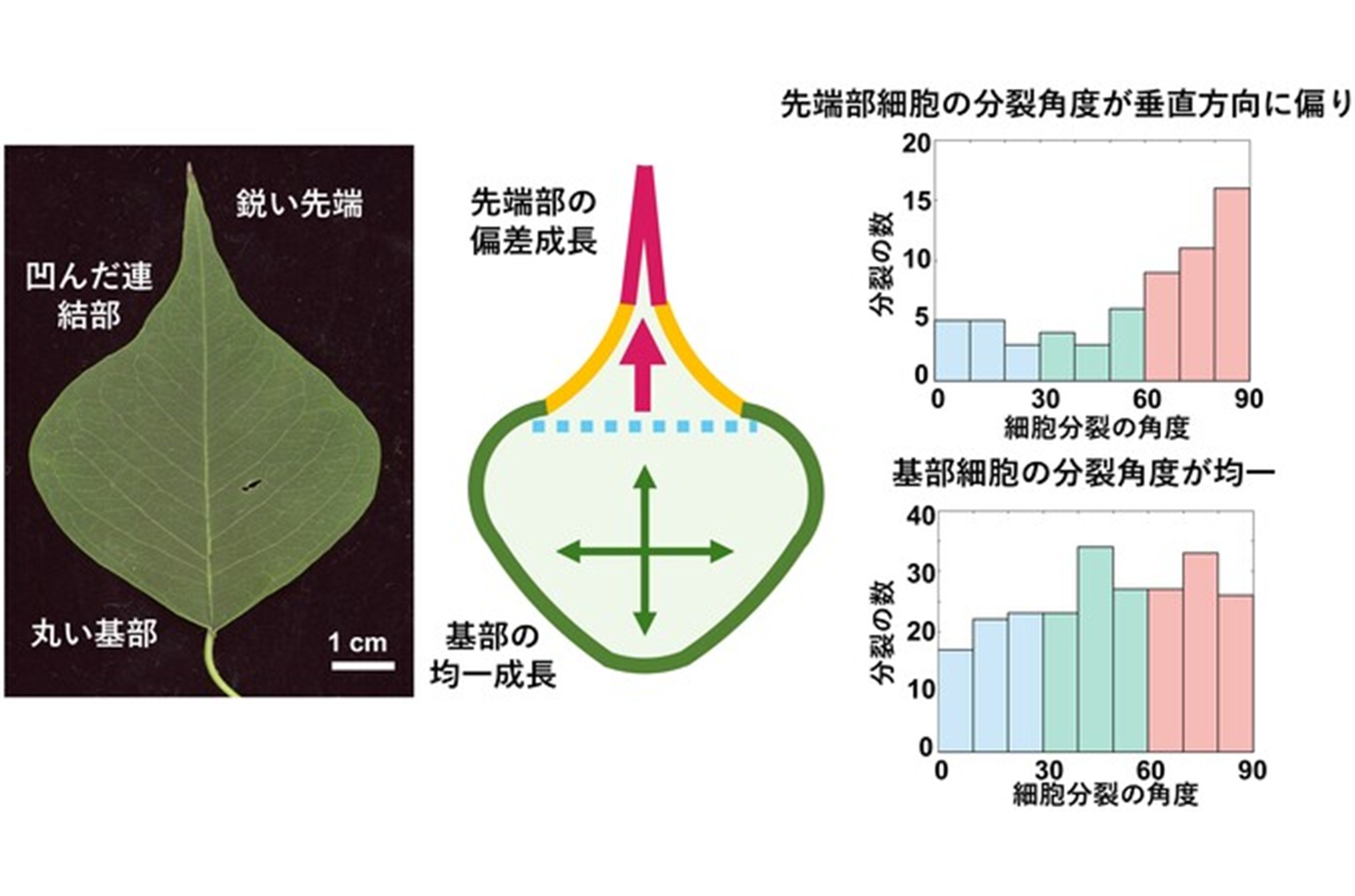
The leaf apex, the distal end of the leaf blade, exhibits enormous variation in shapes across plant species. Among these diverse morphologies, the sharp apex, characterized by its pointed and elongated tip, is important for both species identification and environmental adaptation. Despite its taxonomic and ecological importance, the developmental mechanisms underlying the formation of a sharp apex remain unknown. The present study aims to investigate the curvature patterns and morphogenesis of the sharp apex to uncover these mechanisms using Triadica sebifera leaves. We revealed that the sharp apex marks the maximum positive curvature and is flanked by concave joints with negative curvatures, indicating anisotropic tissue growth and spatially regulated cellular behavior. To investigate the underlying cellular mechanism, we observed cell shapes and cell divisions across different developmental stages and regions. Unlike plant roots or stems, we did not observe highly elongated or aligned cell shapes at the mature stage. Also, unlike serration leaf margins, we did not observe increased cell proliferation near the sharply elongated apex. Instead, we identified a biregional differentiation in cell division angles, and our simulations confirmed that these division angles could generate the sharply elongated apex that might be influenced by anisotropic cell growth. Then, further generalizations were made from this case study of T. sebifera, revealing that spatiotemporal change in cell division angle is essential to make sharp-tipped leaf shape.