2025-07-11 東京大学
<関連情報>
- https://www.h.u-tokyo.ac.jp/press/20250711.html
- https://www.h.u-tokyo.ac.jp/press/__icsFiles/afieldfile/2025/07/11/release_20250711_1.pdf
骨粗鬆症患者におけるテリパラチドと比較したロモソズマブの変形性関節症リスク:標的試験エミュレーション研究 Osteoarthritis risk associated with romosozumab compared with teriparatide in individuals with osteoporosis: a target trial emulation study
Masaki Hatano ∙ Yusuke Sasabuchi ∙ Akira Okada ∙ … ∙ Taku Saito ∙ Sakae Tanaka ∙ Hideo Yasunaga
Annals of the Rheumatic Diseases Published: July 11, 2025
DOI:https://doi.org/10.1016/j.ard.2025.06.2124
ABSTRACT
Objectives
To compare osteoarthritis among individuals with osteoporosis initiating romosozumab vs an active comparator.
Methods
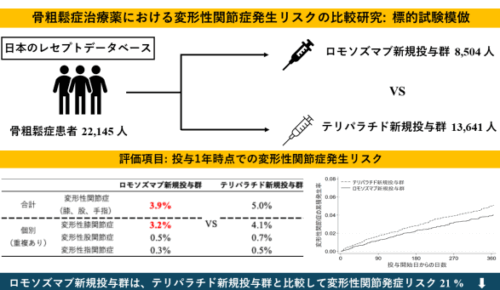
This new user comparative effectiveness study, emulating a target trial, included individuals aged ≥50 years in the administrative claims database from 2019 to 2022. Individuals who initiated romosozumab were compared with those who initiated teriparatide. The primary outcome was the incidence of osteoarthritis, while secondary outcomes included joint-specific osteoarthritis (knee, hip, and hand) at 1 year. Inverse probability of treatment weighting (IPTW) was applied to balance baseline characteristics between romosozumab and teriparatide users, and inverse probability of censoring weighting (IPCW) was employed to account for informative censoring. Absolute risk reduction (ARR) and relative risk (RR) at 1 year were estimated using a weighted Kaplan-Meier estimator.
Results
A total of 22,145 individuals were included in the study (87% female; mean age, 80 years). After IPTW-IPCW adjustment, romosozumab was associated with a lower risk of osteoarthritis compared with teriparatide (ARR, 1.1% [95% CI, 0.5%-1.8%]; RR, 0.79 [0.66, 0.89]). Joint-specific analyses showed the following results: knee osteoarthritis: ARR, 0.8% (95% CI, 0.3%-1.5%), RR, 0.79 (0.66, 0.92); hip osteoarthritis: ARR, 0.2% (95% CI, 0.0%-0.5%), RR, 0.68 (0.37, 1.05); and hand osteoarthritis: ARR, 0.2% (95% CI, 0.0%-0.4%), RR, 0.61 (0.35, 1.06).
Conclusions
Romosozumab was associated with a lower risk of osteoarthritis than teriparatide among individuals with osteoporosis, particularly for knee osteoarthritis. Similar trends were observed for hip and hand osteoarthritis; however, the differences were not significant.