2025-07-31 イリノイ大学アーバナ・シャンペーン校
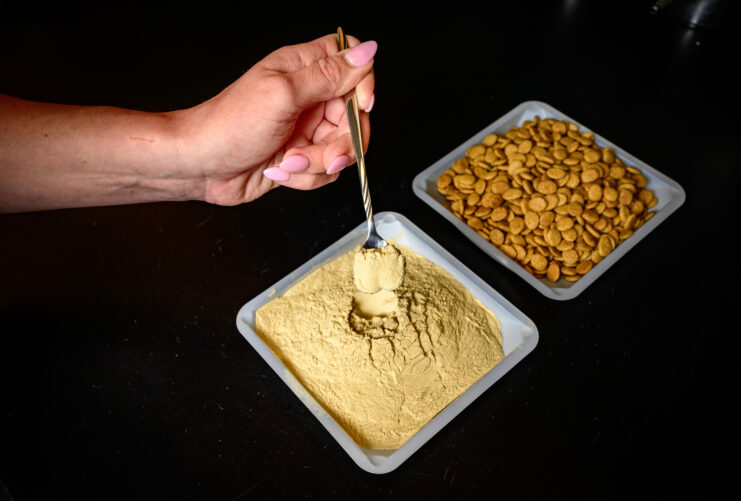
Scientists at project partner Bond Pet Foods created the precision-brewed chicken protein by inserting a peptide from chicken DNA into the genome of brewer’s yeast and cultivating it in stainless steel tanks similar to those used in commercial operations. At left is a tray of the modified brewer’s yeast, and on the right is the dog kibble used in the feeding study at Illinois.
<関連情報>
- https://news.illinois.edu/brewed-chicken-protein-made-by-precision-fermentation-tested-in-pet-food/
- https://www.frontiersin.org/journals/veterinary-science/articles/10.3389/fvets.2025.1593209/full
健康な成犬における醸造鶏タンパク質の安全性、有効性、消化管耐容性、および消化性
Safety, efficacy, gastrointestinal tolerance, and digestibility of brewed chicken protein in healthy adult dogs
Meredith A. Smola,Patrícia M. Oba,Julio C. Mioto,Pernilla Audibert,Tomas Belloso,Kelly S. Swanson
Frontiers in Veterinary Science Published:07 July 2025
DOI:https://doi.org/10.3389/fvets.2025.1593209
Introduction: Producing enough protein continues to be a challenge, but alternatives may provide economic and ecological relief. Sufficient testing is necessary to confirm safety and evaluate nutritional value. Our objective was to evaluate the safety, efficacy, gastrointestinal tolerance, and apparent total tract digestibility (ATTD) of brewed chicken protein (BCP; Saccharomyces cerevisiae expressing a chicken protein).
Methods: Thirty-two healthy adult dogs (BW = 9.68 ± 1.18 kg; age = 4.16 ± 1.85 yr) were used in a completely randomized design (n = 8/treatment). After a 2-wk acclimation phase, baseline measurements were collected and dogs were allotted to the following treatments and fed for 26 wk: control diet (0% BCP; Control), 15% BCP (Low), 30% BCP (Medium), or 40% BCP (High). Palatability was assessed by comparing dry diets coated with 0% (control) vs. 1% BCP in 20 adult dogs. Data were analyzed using the Mixed Models procedure of SAS 9.4, with p < 0.05 being significant and trends accepted at p < 0.10.
Results: Consumption of BCP did not affect food intake, BW, physical parameters, serum chemistry, hematology, and urinalysis. The dry matter, organic matter, and crude protein ATTD were greater (p < 0.05) for High, while the fat ATTD was greater (p < 0.05) for Control. Fecal output was lower (p < 0.0001) and fecal dry matter was lower (p < 0.001) for dogs fed High. Fecal acetate concentrations were lower (p < 0.05) and propionate concentrations tended to be higher (p = 0.06) in dogs fed BCP. Fecal isobutyrate, isovalerate, indole, total phenol and indole, and ammonia concentrations were lower (p < 0.001) and fecal valerate concentrations were higher (p < 0.0001) in dogs fed BCP. Fecal bacterial alpha diversity was lower (p < 0.05) in dogs fed BCP. For beta diversity, dogs fed Control were different than those fed BCP. Over 20 fecal bacterial genera were affected by BCP consumption. Palatability of BCP was high (p < 0.05; 2.93:1 consumption ratio).
Conclusion: These results indicate that the BCP ingredient tested is an effective source of protein that is safe for use in adult dog foods at an inclusion level of up to 40%. No detrimental effects were observed, and notable changes to nutrient digestibility and fecal characteristics, metabolites, and microbiota populations suggest potential benefits on gastrointestinal health.