2025-08-08 基礎生物学研究所,総合研究大学院大学
<関連情報>
STEMIN転写因子は、苔類Physcomitrium patensの再プログラム化过程中、緩やかなクロマチン状態において遺伝子活性化のための選択的なクロマチン再編成を促進する STEMIN transcription factor drives selective chromatin remodeling for gene activation within a relaxed chromatin during reprogramming in the moss Physcomitrium patens
Ruan Morné de Villiers, Gergo Palfalvi, Akinori Kanai, Yutaka Suzuki, Mitsuyasu Hasebe, Masaki Ishikawa
The Plant Journal Published: 01 August 2025
DOI:https://doi.org/10.1111/tpj.70386
SUMMARY
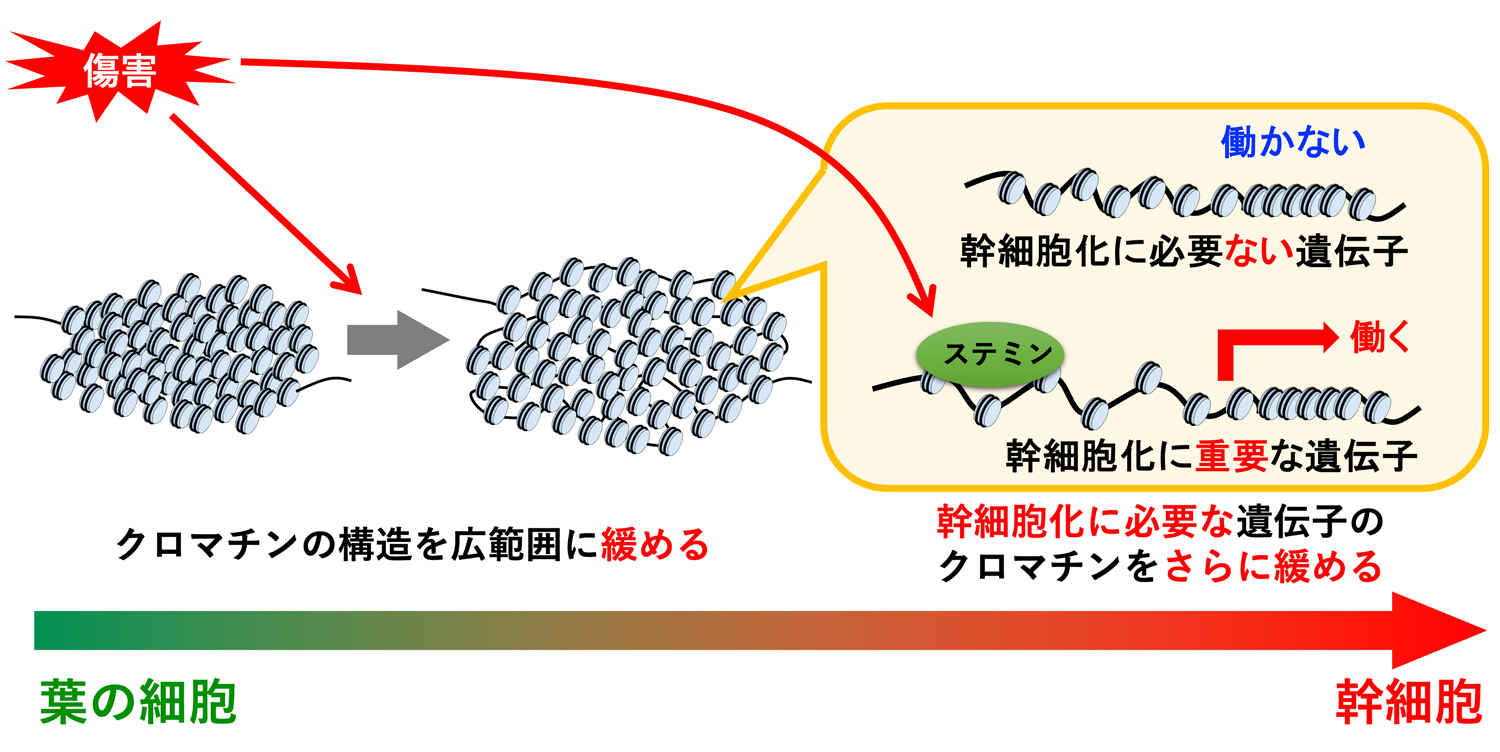
Land plants exhibit remarkable cellular plasticity, readily reprogramming differentiated cells into stem cells in response to internal and external stimuli. While chromatin remodeling is crucial for cellular reprogramming, its interplay with gene expression during reprogramming into stem cells remains elusive. In the moss Physcomitrium patens, wounding induces reprogramming of leaf cells facing wounded cells to change into chloronema apical stem cells through the activation of the AP2/ERF transcription factor STEMIN. In this study, we employed multimodal single-nuclei RNA and ATAC sequencing to explore the interplay between gene expression and chromatin dynamics during STEMIN-mediated reprogramming. Profiling 20 883 single-nuclei from gametophores, protonemata, and cut leaves, we identified 11 distinct cell types including reprogramming leaf cells. Our analysis revealed that reprogramming leaf cells exhibit a partly relaxed chromatin landscape and STEMIN transcription factors selectively enhance accessibility at specific genomic loci essential for stem cell formation. Thus, our results indicate that wounding initiates a broad chromatin relaxation, creating a permissive environment and specific transcription factors act to refine this permissive state by specifically relaxing chromatin regions critical for reprogramming.