2025-08-21 東京大学
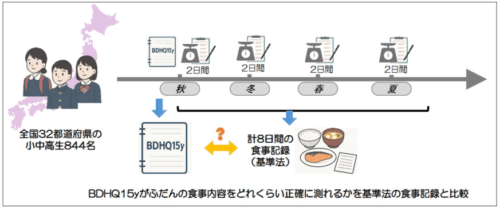
本研究の概要図
<関連情報>
- https://www.u-tokyo.ac.jp/content/400269129.pdf
- https://www.cambridge.org/core/journals/british-journal-of-nutrition/article/relative-validity-of-food-and-nutrient-intakes-derived-from-a-brieftype-diet-history-questionnaire-for-japanese-children-and-adolescents/88802EB82BEF49A0F0DEBAE2101E30FD
日本の子ども及び青少年を対象とした簡易型食事歴質問票から得られた食物及び栄養素摂取量の相対的妥当性 Relative validity of food and nutrient intakes derived from a brief-type diet history questionnaire for Japanese children and adolescents
Hitomi Okubo,Ryoko Tajima,Nana Shinozaki,Shizuko Masayasu,Satoshi Sasaki and Kentaro Murakami
British Journal of Nutrition Published:26 August 2025
DOI:https://doi.org/10.1017/S0007114525104042
Abstract
The aim of this study was to evaluate the relative validity of food and nutrient intakes estimated by a brief-type diet history questionnaire for Japanese children and adolescents (BDHQ15y) designed to assess habitual dietary intake during the previous month. A total of 432 boys and 412 girls aged 6–17 years from thirty-two prefectures in Japan completed the BDHQ15y and subsequently provided 8-day weighed dietary records (DR) on two non-consecutive days over four seasons for comparison. Among the intakes of forty-four nutrients and thirty-one food groups adjusted for energy intake using the density model, the BDHQ15y showed percentage differences in median intake of less than 10 % compared with the DR for nineteen nutrients in both sexes, as well as for eleven and seven food groups in boys and girls, respectively, indicating good agreement for key nutrients and food groups, including protein, fat, carbohydrate, dietary fibre, grains, vegetables, dairy products and sugar-sweetened beverages (SSB). The median values (25th–75th percentiles) of Spearman’s correlation coefficients in boys and girls were 0·33 (0·28–0·38) and 0·28 (0·23–0·35) for nutrients, respectively, and 0·36 (0·29–0·42) and 0·29 (0·24–0·36) for food groups, respectively. Bland–Altman plots showed wide limits of agreement, with overestimation at higher intakes for most nutrients and food groups, except SSB. In conclusion, the BDHQ15y shows promise for large-scale dietary monitoring, particularly for estimating group-level intakes of key nutrients and food groups. However, its limited ability to rank individual intakes and the variability in individual-level assessments necessitate cautious interpretation and application.