2025-09-02 国立成育医療研究センター
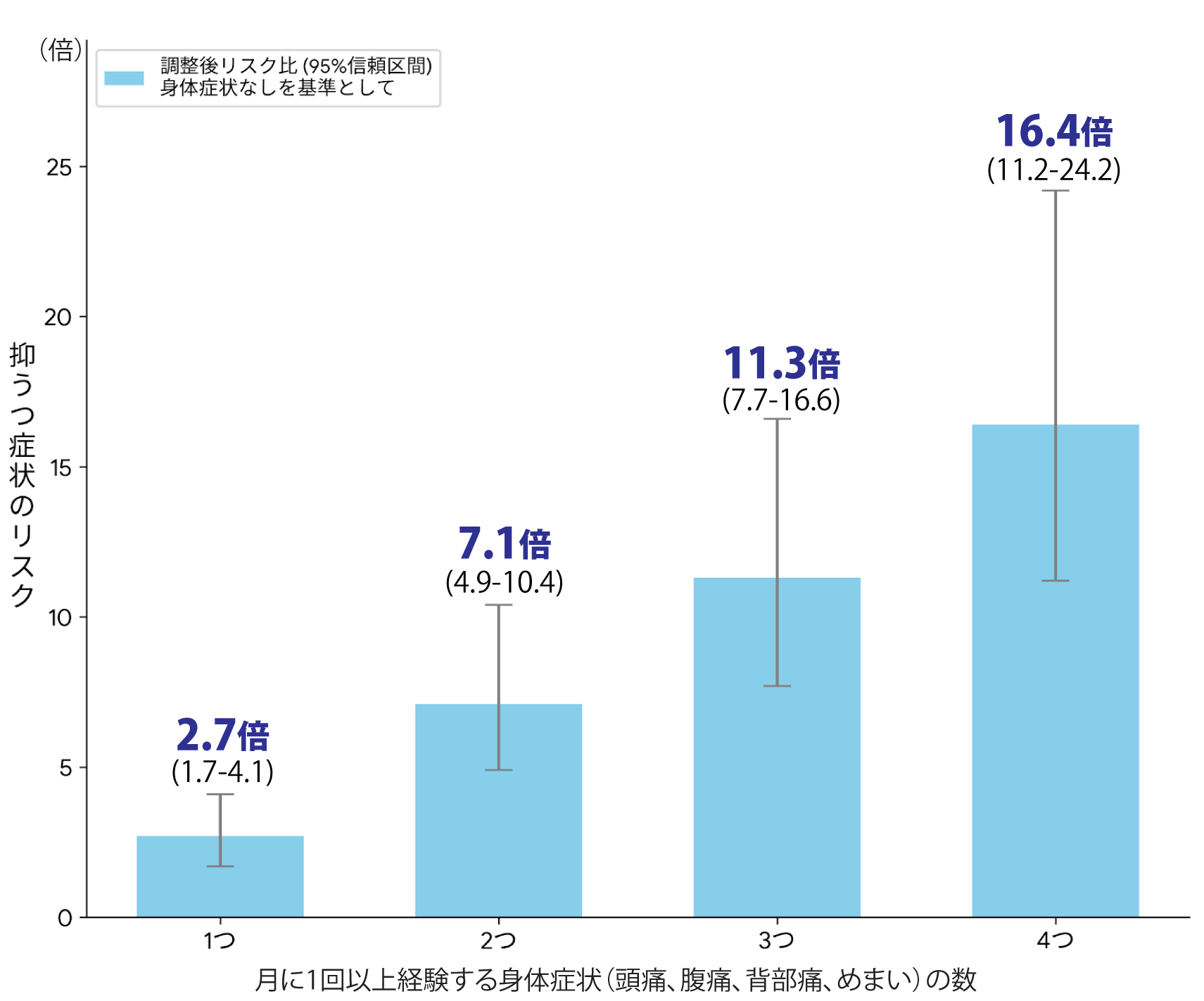 【図1:身体症状の「数」と抑うつ症状のリスク】
<関連情報>
- https://www.ncchd.go.jp/press/2025/0902.html
- https://www.ncchd.go.jp/press/assets/0902.pdf
- https://link.springer.com/article/10.1007/s00431-025-06399-9
10~15歳日本児童における抑うつ症状と関連する身体症状の頻度・数:人口ベース研究 Frequency and number of somatic symptoms in association with depressive symptoms in Japanese children aged 10–15: a population-based study
Kazuma Shinno,Kazue Ishitsuka,Aurelie Piedvache & Naho Morisaki
European Journal of Pediatrics Published:20 August 2025
DOI:https://doi.org/10.1007/s00431-025-06399-9
Abstract
This study investigated the association between the frequency and number of major somatic symptoms (headache, stomachache, back pain, dizziness) and depressive symptoms among adolescents. We conducted a nationwide, population-based self-reported questionnaire survey of adolescents aged 10–15. We defined depressive symptoms as scoring 10 or higher on the Patient Health Questionnaire for Adolescents. We calculated adjusted risk ratios using modified Poisson regression and examined diagnostic accuracy with univariate and multivariate receiver operating characteristic analysis. Among 2268 adolescents, 254 (11.2%) had depressive symptoms; 218 (85.8%) experienced at least one somatic symptom once a month or more. The risk of depressive symptoms increased with the number of somatic symptoms reported more than once a month, from a risk ratio of 2.7 (95% confidence interval [95%CI], 1.7–4.1) for one symptom to 16.4 (95%CI, 11.2–24.2) for four, compared to no symptoms. Any somatic symptoms once a month were associated with depressive symptoms with 85.8% sensitivity, while three or more somatic symptoms had 92.8% specificity. Models classifying depressive symptoms by the number of somatic symptoms performed moderately well (area under the curve, 0.80 [95%CI, 0.76–0.82]) and outperformed models based on the frequency of any single somatic symptom.
Conclusion: This population-based study found that the risk of depressive symptoms increases with both the number of symptoms observed at least once a month and the frequency of somatic symptoms. Monitoring the frequency and number of somatic symptoms may offer an efficient, low-threshold screening method for depressive symptoms in adolescents.