
2025-09-28 中国科学院(CAS)
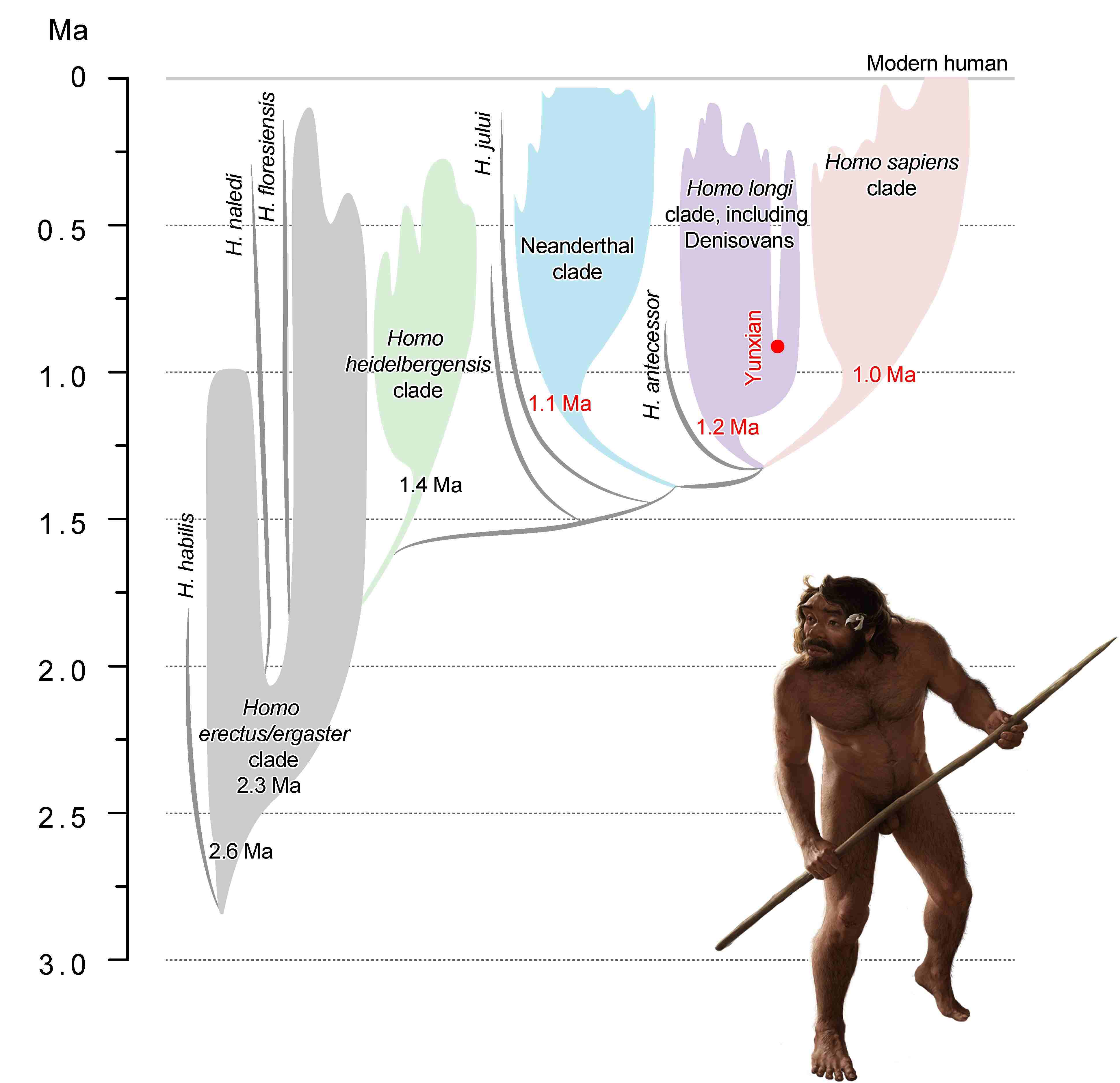
The human family tree. (Image by NI Xijun, BAI Jiannan)
<関連情報>
- https://english.cas.cn/newsroom/research_news/life/202509/t20250924_1055290.shtml
- https://www.science.org/doi/10.1126/science.ado9202
雲仙人の頭蓋骨の系統学的位置はホモ・ロンギとデニソワ人の起源を解明する The phylogenetic position of the Yunxian cranium elucidates the origin of Homo longi and the Denisovans
Xiaobo Feng, Qiyu Yin, Feng Gao, Dan Lu, […] , and Xijun Ni
Science Published:25 Sep 2025
DOI:https://doi.org/10.1126/science.ado9202
Editor’s summary
It is now well known that there were at one time many Homo lineages. Understanding of the differences among these lineages is largely dependent upon crania that are rare and often damaged and deformed by age. Feng et al. reconstructed the 1-million-year-old Yunxian 2 cranium using an approach that allowed for removal of much of the compression and distortion naturally present in the fossil. In doing so, they found that the cranium contained both primitive and derived traits and concluded that it is representative of the H. longi clade, which is sister to H. sapiens and likely contained the Denisovans. —Sacha Vignieri
Abstract
Diverse forms of Homo coexisted during the Middle Pleistocene. Whether these fossil humans represent different species or clades is debated. The ~1-million-year-old Yunxian 2 fossil from China is important for understanding the cladogenesis of Homo and the origin of Homo sapiens. In this study, we restored and reconstructed the distorted Yunxian 2 cranium using recently introduced technology. The results show that this cranium displays mosaic primitive and derived features. Morphometric and phylogenetic analyses suggest that it is an early member of the Asian H. longi clade, which includes the Denisovans and is the main part of the sister group to the H. sapiens clade. Both the H. sapiens and H. longi clades have deep roots extending beyond the Middle Pleistocene and probably experienced rapid early diversification. Yunxian 2 may preserve transitional features close to the origins of the two clades.

