2025-09-30 京都大学
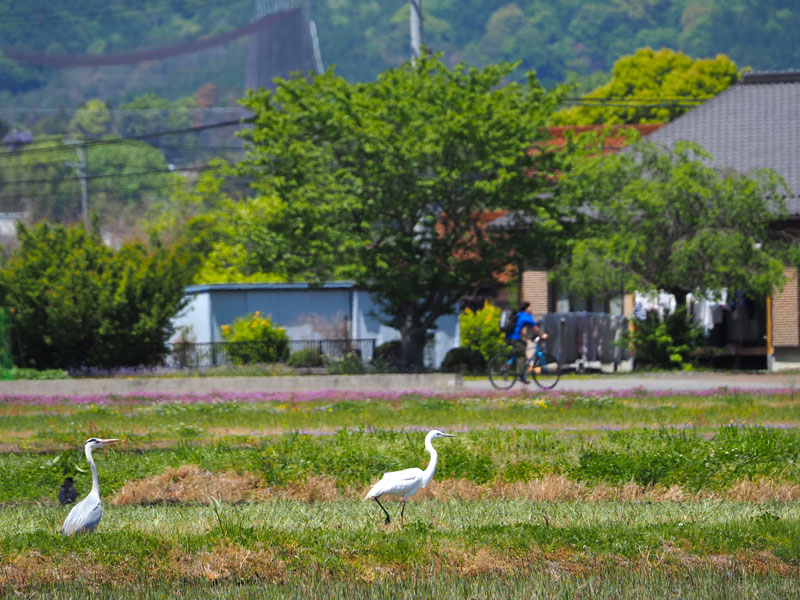
広島県東広島市で、自宅から広島大学の職場へ通勤する途中に行った、「“ゆる”定点調査」風景の一例(京都大学在籍時は宇治市の自宅から京都市の職場への通勤時も同様に実施)。こうした調査は計画的でなく、思い立ったらいつでもどこでも実施可能。(撮影:久野真純)
<関連情報>
- https://www.kyoto-u.ac.jp/ja/research-news/2025-09-30
- https://www.kyoto-u.ac.jp/sites/default/files/2025-09/2509_Eco%26Evo_Hisano_relj%20web_s-0592ab538a46746f1659656a68e5c6ab.pdf
- https://onlinelibrary.wiley.com/doi/10.1002/ece3.72176
いつでもどこでもできる“ゆる”定点調査のすすめ:市⺠科学の ⼤規模⿃類群集データ収集の促進に向けて Facilitating Large-Scale Bird Biodiversity Data Collection in Citizen Science: ‘Relaxed’ Point Counts for Anytime, Anywhere Monitoring
Masumi Hisano
Ecology and Evolution Published: 25 September 2025
DOI:https://doi.org/10.1002/ece3.72176
ABSTRACT
Citizen science has expanded biodiversity monitoring, yet many datasets lack standardisation in spatial and temporal coverage and survey protocols. In birds, for example, traditional point count surveys often impose strict requirements on location, timing and spacing between survey points, limiting opportunities for casual, at-ease participation in data collection. To address these constraints, this paper proposes a ‘relaxed’ point-count survey method to enhance accessibility and expand geographic coverage by easing these constraints. Surveys can be conducted in diverse locations, including urban areas and travel or daily-routine routes, within flexible timeframes (e.g., not only within 6 h after sunrise but also afternoon/evening) and seasons (e.g., including non-breeding periods), with adaptable spacing between points and the option for repeated counts at the same location on different days. The framework addresses spatial and temporal autocorrelation, as well as variability in observer skill and environmental conditions through statistical adjustments using random effects and covariates. Preliminary data collected opportunistically across a large area of western Canada demonstrate the feasibility of this approach, yielding cross-biome community data within a short timeframe. By engaging birdwatchers and citizens, this approach facilitates the collection of large-scale, standardised species assemblage data beyond single-species observations. This inclusive and scalable strategy offers new opportunities for biodiversity monitoring, particularly in human-modified landscapes. This inclusive and scalable framework offers new opportunities for biodiversity monitoring, particularly in urban and human-modified landscapes.