2025-10-02 コペンハーゲン大学(UCPH)
<関連情報>
- https://news.ku.dk/all_news/2025/10/new-method-enables-researchers-to-investigate-the-cause-of-heart-diseases/
- https://www.nature.com/articles/s44161-025-00721-2
ホルマリン固定パラフィン包埋心臓標本の定量的プロテオミクスにより、特定の領域および患者群のタンパク質シグネチャーが明らかになる Quantitative proteomics of formalin-fixed, paraffin-embedded cardiac specimens uncovers protein signatures of specialized regions and patient groups
Jonathan S. Achter,Thomas H. L. Jensen,Paola Pisano,Johan S. Bundgaard,Daniel Raaschou-Oddershede,Kasper Rossing,Michael Wierer & Alicia Lundby
Nature Cardiovascular Research Published:26 September 2025
DOI:https://doi.org/10.1038/s44161-025-00721-2
Abstract
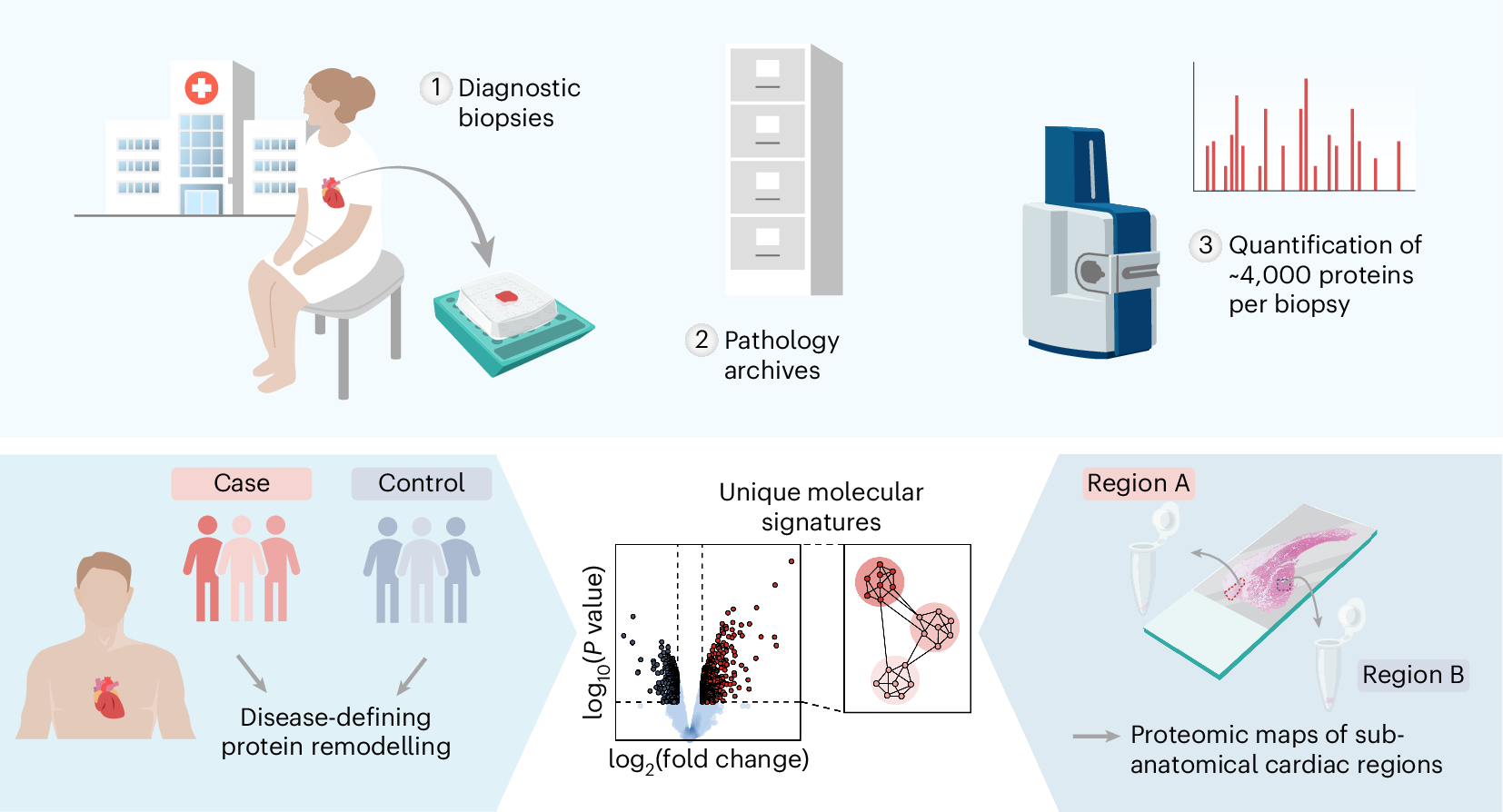
Proteomic technologies have advanced our understanding of disease mechanisms, patient stratification and targeted therapies. However, applying cardiac proteomics in translational research requires overcoming the barrier of tissue accessibility. Formalin-fixed, paraffin-embedded (FFPE) heart tissue, widely preserved in pathology collections, remains a largely untapped resource. Here we demonstrate that proteomic profiles are well preserved in FFPE human heart specimens and compatible with high-resolution, quantitative analysis. Quantifying approximately 4,000 proteins per sample, we show this approach effectively distinguishes disease states and subanatomical regions, revealing distinct underlying protein signatures. Specifically, the human sinoatrial node exhibited enrichment of collagen VI and G protein-coupled receptor signaling. Myocardial biopsies from patients with arrhythmogenic cardiomyopathy were characterized by fibrosis and metabolic/cytoskeletal derangements, clearly separating them from donor heart biopsies. This study establishes FFPE heart tissue as a robust resource for cardiac proteomics, enabling retrospective molecular profiling at scale and unlocking archived specimens for disease discovery and precision cardiology.