
2025-11-17 国立環境研究所
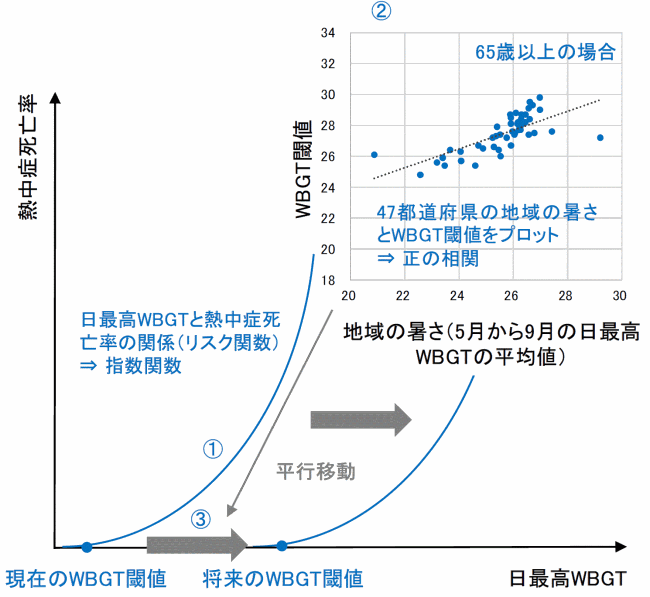
図1 気候変動により地域の暑さが増した場合の暑熱適応を考慮する方法。日最高WBGTと熱中症死亡率の関係を指数関数で示すことができる(①)。地域の暑さとWBGT閾値には正の相関がある(②)。気候変動により地域の暑さが増した際に、この相関を用いWBGT閾値とリスク関数を日最高WBGT側に平行にシフトさせることで暑熱適応を考慮した(③)。
<関連情報>
- https://www.nies.go.jp/whatsnew/2025/20251117/20251117.html
- https://www.sciencedirect.com/science/article/pii/S0013935125022650
日本における将来の熱中症死亡率:気候、人口動態の変化、長期的な暑熱適応の影響 Future heatstroke mortality in Japan: Impacts of climate, demographic changes, and long-term heat adaptation
Kazutaka Oka, Vera Ling Hui Phung, Jinyu He, Yasushi Honda, Masahiro Hashizume, Yasuaki Hijioka
Environmental Research Available online: 3 October 2025
DOI:https://doi.org/10.1016/j.envres.2025.123012
Highlights
- Future risk of heatstroke mortality across Japan’s 47 prefectures is projected.
- An empirical, evidence-based method is used to account for heat adaptations.
- Heat adaptation reduced the projected increase in heatstroke mortality risk.
- Japan’s aging population amplified future heatstroke mortality among the elderly.
Abstract
The International Classification of Diseases (ICD)-10: X30, an indicator that reflects the direct health impacts of excessive natural heat, has rarely been applied in Japan. This study projects heatstroke mortality for all 47 prefectures in Japan using ICD-10: X30, accounting for demographic changes and long-term heat adaptation (HA)—two key factors influencing heatstroke risk. Projections were made for two age groups (<65 and ≥ 65 years) using five climate models under three greenhouse gas (GHG) emission scenarios aligned with shared socio-economic pathways (SSP1-RCP2.6, SSP2-RCP4.5, and SSP5-RCP8.5) across three time periods: base year (1995–2014), mid-21st century (2031–2050), and end of the 21st century (2081–2100). By the end of the 21st century, in the absence of HA, the average heatstroke mortality rate (HMR; cases per population) in Japan is projected to increase 4.26- and 3.63-fold for the <65-year and ≥65-year groups, respectively, relative to the base year, under all climate models and GHG scenarios. With HA, these increases were reduced to 1.76- and 1.49-fold for the <65-year and ≥65-year groups, respectively. Without HA, the average number of heatstroke mortality cases (HMC) is projected to increase 2.07- and 3.86-fold for the <65-year and ≥65-year groups, respectively, relative to the base year, by the end of the 21st century. With HA, these values were reduced to 0.88- and 1.58-fold, respectively. Both HMR and HMC decreased when HA was considered. These findings suggest that incorporating long-term adaptation measures into heatstroke risk management would enhance the effectiveness of public health planning.

