2026-01-06 国立長寿医療研究センター
<関連情報>
- https://www.ncgg.go.jp/ri/report/20251223.html
- https://www.ncgg.go.jp/ri/report/documents/20251223.pdf
- https://www.mdpi.com/2218-273X/15/10/1367
アルツハイマー病における白質高信号と血漿胎盤成長因子の関連性 Association of Plasma Placental Growth Factor with White Matter Hyperintensities in Alzheimer’s Disease
Kazuya Igarashi,Tamao Tsukie,Kazuo Washiyama,Kiyoshi Onda,Yuki Miyagi,Shoya Inagawa,Soichiro Shimizu,Akinori Miyashita,Osamu Onodera,Takeshi Ikeuchi and Kensaku Kasuga
Biomolecules Published: 26 September 2025
DOI:https://doi.org/10.3390/biom15101367
Abstract
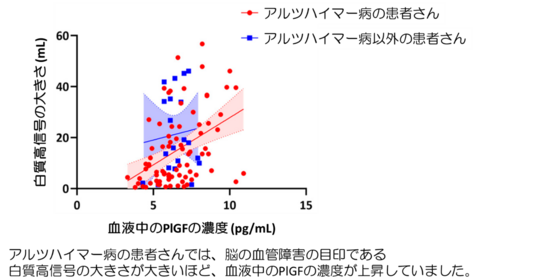
Autopsy studies have shown that Alzheimer’s disease (AD) often coexists with cerebrovascular injury, affecting cognitive outcomes and the effectiveness of anti-amyloid-beta (Aβ) drugs. No fluid biomarkers of cerebrovascular injury have been identified yet. We investigated the association between white matter hyperintensities (WMH) severity and fluid biomarkers, including cerebrospinal fluid (CSF) neurofilament light chain and plasma placental growth factor (PlGF) levels. This study included 242 patients from memory clinics. Magnetic resonance imaging (MRI), CSF, and plasma samples were collected. Patients were classified as AD+ or non-AD based on the CSF Aβ42/Aβ40 ratio. In the discovery cohort (79 AD+ and 20 non-AD patients with 3D-T1 images), we analyzed the association between WMH volume and plasma PlGF. In the validation cohort (54 AD+ patients without 3D-T1 images), we analyzed the association between WMH grading and plasma PlGF. Among AD+ patients in the discovery cohort, plasma PlGF levels remained significantly associated with WMH volume and grading after adjusting for age, sex, and global cognition. Among the AD+ patients in the validation cohort, the high-PlGF (above median) group had significantly greater WMH volumes and a higher number of patients with a high WMH grading than the low-PlGF (below median) group. Plasma PlGF is a promising marker of cerebrovascular injury in AD.