2026-01-14 東京大学医科学研究所
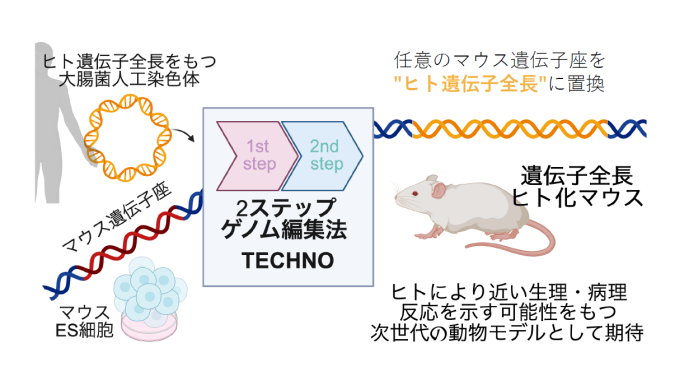
遺伝子全長ヒト化マウスの作製を可能にする「TECHNO」
<関連情報>
- https://www.ims.u-tokyo.ac.jp/imsut/jp/about/press/page_00370.html
- https://www.nature.com/articles/s41467-025-67900-4
多様なゲノム座位における全長遺伝子ヒト化マウスを生成するためのスケーラブルな2段階ゲノム編集戦略 A scalable two-step genome editing strategy for generating full-length gene-humanized mice at diverse genomic loci
Jumpei Taguchi,Mio Kikuchi,Hyojung Jeon,Ryo Shimizu,Hideto Mori,Masahito Ikawa,Yasuhiro Yamada,Kei Sato,Terumasa Ikeda,Satoshi Yamazaki & Manabu Ozawa
Nature Communications Published:14 January 2026
DOI:https://doi.org/10.1038/s41467-025-67900-4
Abstract
Full-length gene-humanized mice engineered by completely replacing mouse loci with human counterparts, including untranslated and regulatory regions, provide a robust in vivo platform for human gene function studies. However, reliably humanizing large genomic regions remains challenging due to limited DNA insert sizes, complex protocols, and specialized material requirements. This study introduces a streamlined approach that enables full-length gene humanization through two sequential CRISPR-assisted homologous recombination steps in embryonic stem cells. This method supports targeted knock-in of genomic fragments ( > 200 kbp) and is applicable across multiple mouse strains. Humanized alleles generated using the developed method recapitulate human-like splicing isoforms and organ-specific gene expression while restoring essential functions in hematopoiesis, spermatogenesis, and survival. Furthermore, disease-associated mutations can be engineered into humanized alleles to model human genetic disorders in vivo. This versatile platform enables the creation of physiologically relevant, fully gene-humanized mouse models for broad applications in biomedical research.