2026-01-16 奈良先端科学技術大学院大学,理化学研究所,東京農業大学,埼玉大学
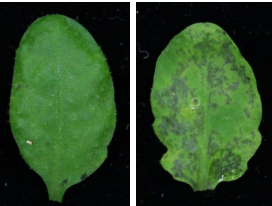
通常湿度 高湿度
図1. 高湿度では病原細菌に感染した葉は顕著な病徴を示す。
<関連情報>
湿度によるABA枯渇は、葉の水分をめぐる植物病原菌の競争を決定づける Humidity-driven ABA depletion determines plant-pathogen competition for leaf water
Shigetaka Yasuda,Akihisa Shinozawa,Yuanjie Weng,Arullthevan Rajendram,Taishi Hirase,Haruka Ishizaki,Ryuji Suzuki,Shioriko Ueda,Rahul Sk,Yumiko Takebayashi,Izumi Yotsui,Masatsugu Toyota,Masanori Okamoto & Yusuke Saijo
Nature Communications Published:19 December 2025
DOI:https://doi.org/10.1038/s41467-025-67469-y
Abstract
Bacterial phytopathogens, such as Pseudomonas syringae pv. tomato (Pst) DC3000, induce water-soaked lesions in the leaf apoplast under high humidity, facilitating infection. However, it remains largely unclear how plants regulate their resistance to restrict bacterial infection in response to humidity. Here, we demonstrate that abscisic acid (ABA)-catabolizing ABA 8’-hydroxylase, encoded by CYP707A3, plays a critical role in this resistance in Arabidopsis thaliana. Elevated humidity induces CYP707A3 expression, which is essential for reducing ABA levels and promoting stomatal opening, thereby limiting bacterial water-soaking and infection following leaf invasion. High humidity also increases cytosolic Ca2+ levels via the Ca2+ channels CNGC2 and CNGC4, with partial involvement from CNGC9, activating the calmodulin-binding transcription activator CAMTA3 to drive CYP707A3 induction. However, Pst DC3000 counteracts this defense response using type III secretion effectors, including AvrPtoB, facilitating water-soaking. These findings provide insights into the mechanisms underlying the competition between plants and bacteria for leaf water under elevated humidity.