2026-01-19 カロリンスカ研究所(KI)
<関連情報>
- https://news.ki.se/new-method-predicts-asthma-attacks-up-to-five-years-in-advance
- https://www.nature.com/articles/s41467-025-67436-7
スフィンゴ脂質とステロイドの循環レベル比は喘息の悪化を予測する The ratio of circulatory levels of sphingolipids to steroids predicts asthma exacerbations
Yulu Chen,Pei Zhang,Mengna Huang,Priyadarishini Kachroo,Antonio Checa,Qingwen Chen,Kevin Mendez,Meryl Stav,Nicole Prince,Sofina Begum,Andrea Aparicio,Tao Guo,Rinku Sharma,Su H. Chu,Rachel S. Kelly,Julian Hecker,Ayobami Akenroye,Amber Dahlin,Scott T. Weiss,Michael McGeachie,Craig E. Wheelock & Jessica A. Lasky-Su
Nature Communications Published:19 January 2026
DOI:https://doi.org/10.1038/s41467-025-67436-7
Abstract
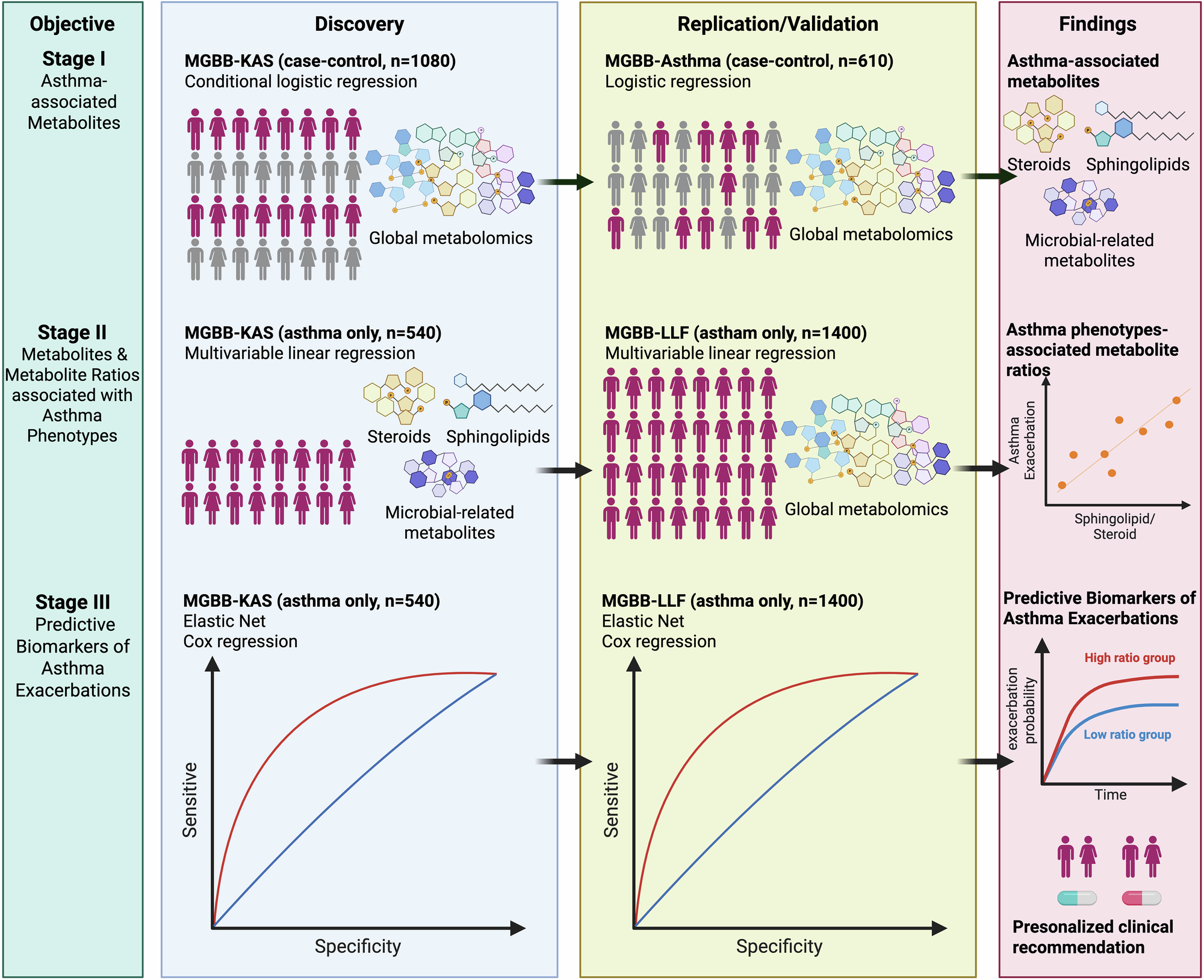
The lack of biomarkers to identify individuals at risk of asthma exacerbations remains a significant limitation to improving patient outcomes. To address this need, we analyze data from three asthma cohorts, combining up to 25 years of electronic medical records with sequential metabolomics studies, to develop and replicate a predictive model for asthma exacerbation risk. We identify asthma-associated biochemical pathways via global circulatory metabolomics and then apply targeted mass spectrometry methods to quantify selected steroids, sphingolipids, and microbial-derived metabolites. The sphingolipid-to-steroid ratios robustly associate with 5-year exacerbation risk (discovery p value = 1.63×10⁻26-0.029; replication p value = 1.89×10⁻36-0.033). Based upon these findings, we derive and replicate a simple 5-year predictive model of asthma exacerbations using 21 sphingolipid-to-steroid ratios that outperforms current clinical measures (discovery AUC = 0.90; replication AUC = 0.89). These findings underscore the value of metabolomic profiling to develop a practical, cost-effective clinical assay for asthma exacerbation risk that may improve patient care.