
2026-01-23 京都大学
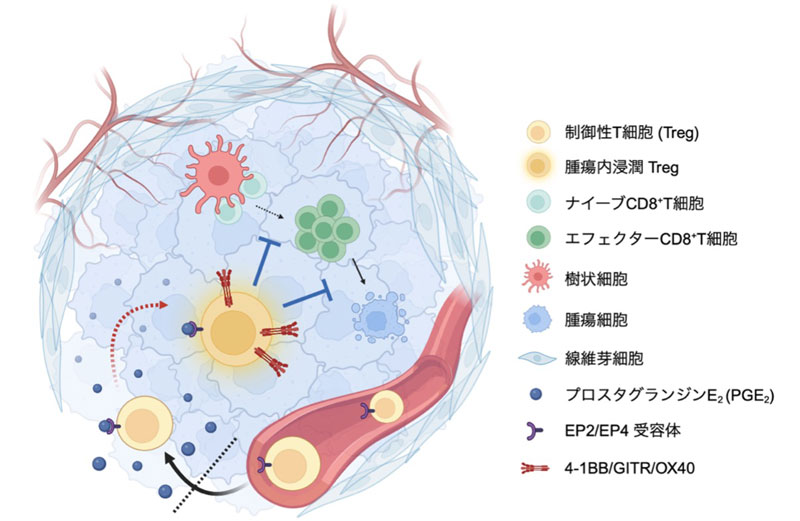
腫瘍環境におけるTregに対するPGE₂の作用の概念図
<関連情報>
- https://www.kyoto-u.ac.jp/ja/research-news/2026-01-23-4
- https://www.kyoto-u.ac.jp/sites/default/files/2026-01/web_2601_Narumiya-d21466671ba92d4980ad8a687b99b6b1.pdf
- https://www.pnas.org/doi/10.1073/pnas.2424251122
プロスタグランジンE 2 -EP2/EP4シグナル伝達は腫瘍増殖のための腫瘍浸潤性Treg表現型を誘導する Prostaglandin E2-EP2/EP4 signaling induces the tumor-infiltrating Treg phenotype for tumor growth
Ryuma Matsuura, Siwakorn Punyawatthananukool, Ryoji Kawakami, +2 , and Shuh Narumiya
Proceedings of the National Academy of Sciences Published:December 4, 2025
DOI:https://doi.org/10.1073/pnas.2424251122
Significance
Regulatory T cells (Tregs) are enriched in the tumor microenvironment (TME) and contribute to immune evasion. These tumor-infiltrating Tregs (TI-Tregs) are highly suppressive and express a unique set of genes, which are conserved across species and tumor types and stages. Such commonality suggests the presence of a core mechanism of inducing the TI-Treg signature in TME. However, such a mechanism has not been identified. Here, we found that prostaglandin E2(PGE2) produced in TME confers the TI-Treg signature to Tregs via its receptors, EP2 and EP4. Clinical involvement of this mechanism is validated by single-cell RNA sequencing (scRNA-seq) analysis of human tumor samples. These findings set a rationale for therapeutic intervention of PGE2-EP2/EP4 signaling in treatment of human cancers.
Abstract
Foxp3+ regulatory T cells (Tregs) heavily infiltrate malignant tumors and restrict antitumor immunity. These tumor-infiltrating Tregs (TI-Tregs) adopt a distinct phenotype by expressing a unique set of genes. This TI-Treg gene expression signature is conserved in TI-Tregs across species and tumor types and stages, suggesting the presence of a common inducing mechanism in the tumor microenvironment (TME). However, identity of such a mechanism remains elusive. Here, we show that prostaglandin E2 (PGE2) produced in TME directly acts on its receptor EP2/EP4 on Tregs to induce the TI-Treg phenotype. PGE2 added to TCR-activated Tregs induces a set of genes, many of which are included in the TI-Treg signature, in both induced Tregs (iTregs) and naturally occurring Tregs (nTregs) via EP2/EP4- cAMP-PKA pathway. Concomitantly, PGE2-treated Tregs exhibit potent suppressive activity to CD8+ T cells and strongly inhibit their proliferation in an EP4 dependent manner. Consistently, selective loss of EP2 and EP4 in mouse Tregs reduces expression of those genes in Tregs infiltrating Lewis lung carcinoma 1 (LLC1) mouse tumor and significantly delays the tumor progression. In human FOXP3+iTregs, PGE2-EP4 signaling upregulated the expression of Treg signature genes, FOXP3, CD25, and CTLA-4 as well as a typical TI-Treg signature gene, 4-1BB, and enhanced suppressive activity. Furthermore, analysis of single-cell RNA sequencing of nasopharyngeal cancer patients demonstrates preferential expression of the TI-Treg signature genes in Tregs infiltrating the PTGS2hi tumor group compared to the PTGS2lo tumor group. These findings suggest that PGE2-EP2/EP4 signaling is one of the core mechanisms inducing the TI-Treg phenotype in TME for tumor growth.

