2026-01-26 長崎大学
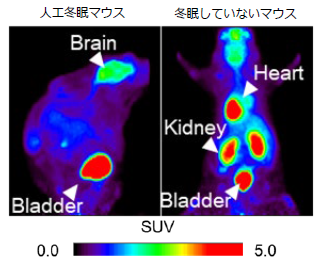
図1)人工冬眠マウスでは、[18F]FDG の集積パターンが大きく異なっている。
<関連情報>
- https://www.nagasaki-u.ac.jp/ja/science/science434.html
- https://www.sciencedirect.com/science/article/pii/S0006291X26000318
マウスにおけるQニューロン誘導冬眠様状態中の代謝陽電子放出断層撮影イメージングと腫瘍増殖抑制 Metabolic positron emission tomography imaging and tumor growth inhibition during the Q neuron-induced hibernation-like state in mice
Shoko Nomura, Wakiko Arakaki, Akari Kato, Naomi Fujie, Kiyomi Ishikawa, Ayaka Wataki, Hiroaki Ono, Tsuyoshi Tahara, Yasuhiro Wada, Yasuyoshi Watanabe, Hisashi Doi, Genshiro A. Sunagawa, Hidefumi Mukai
Biochemical and Biophysical Research Communications Available online: 12 January 2026
DOI:https://doi.org/10.1016/j.bbrc.2026.153268
Highlights
- We conducted the first PET study of QIH mice to assess metabolism during hibernation.
- Three metabolic probes derived from glucose, amino acid, and vitamin were used.
- Cardiac glucose metabolism was significantly reduced during the QIH state.
- QIH induction dramatically suppressed the growth of subcutaneous transplanted tumors.
Abstract
To the best of our knowledge, this is the first positron emission tomography (PET) study using a Q neuron–induced hypothermia and hypometabolism (QIH) mouse model, which is a synthetic hibernation-like state triggered by neural stimulation. We investigated changes in the in vivo dynamics of various essential nutrients and bioactive substances during hibernation using three types of metabolic probes: the glucose derivative [18F]FDG (fluorodeoxyglucose), amino acid derivative L-m-[11C]tolylalanine, and vitamin B1 derivative [11C]thiamine. We found that cardiac glucose metabolism was significantly reduced during the QIH state. Both vitamin B1 and the amino acid derivatives exhibited rapid systemic distribution immediately after intravenous administration, which may indicate increased translocation into tissues based on altered circulatory dynamics or vascular wall properties. We also found that the proliferation of subcutaneously inoculated tumors was dramatically suppressed by QIH. Recently, hibernation has increasingly attracted attention because of its advantages, including reduced oxygen and energy consumption, that can mitigate organ damage. Notably, hibernation-like states may have potential applications in emergency and critical care medicine. Therefore, the advancement of hibernation research using QIH models and highlighted the potential of hibernation-like states for novel applications in cancer therapy and drug delivery.