2026-02-06 ゲーテ大学
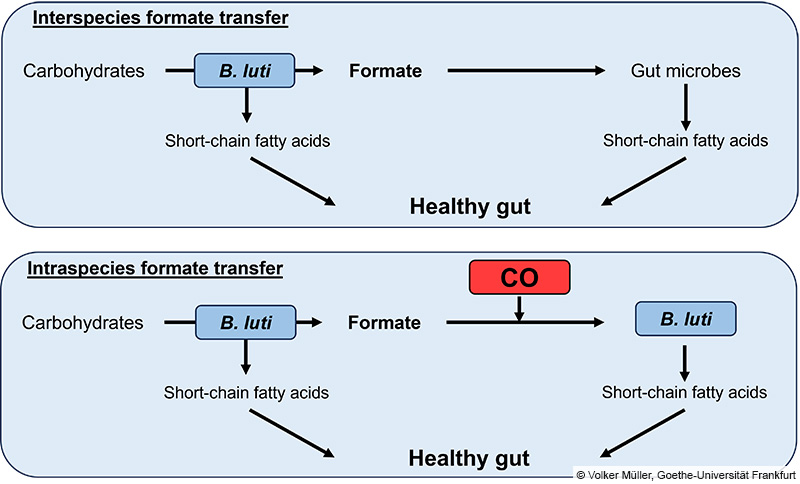
Top: During interspecies formate transfer, B. luti consumes carbohydrates and produces short-chain fatty acids such as lactate, acetate, or succinate, but also formate. The short-chain fatty acids are then absorbed by the intestine. Formate is absorbed by other intestinal microbes and converted into short-chain fatty acids and methane (not shown). Below: During intraspecies formate transfer, B. luti metabolizes the formate with carbon monoxide (CO) or hydrogen (not shown) to produce short-chain fatty acids such as acetate. Short-chain fatty acids contribute to intestinal health. © Volker Müller, Goethe-University Frankfurt
<関連情報>
- https://aktuelles.uni-frankfurt.de/english/taxiing-through-the-gut-formic-acid-in-the-microbiome/
- https://www.tandfonline.com/doi/full/10.1080/19490976.2025.2609406
腸内アセトゲンBlautia lutiにおける電子伝達体としてのギ酸:腸内微生物叢における電子伝達モデル Formate as electron carrier in the gut acetogen Blautia luti: a model for electron transfer in the gut microbiome
Raphael Trischler & Volker Müller
Gut Microbes Published:02 Jan 2026
DOI:https://doi.org/10.1080/19490976.2025.2609406
Abstract
Species of the genus Blautia are commonly found in the human gut and are known to be beneficial for the human well-being. However, only little is known about the physiology and the specific role of Blautia species in the human gut. In this study, we investigated the heterotrophic metabolism of the formate dehydrogenase lacking gut acetogen Blautia luti. We identified acetate, succinate, lactate, formate, and hydrogen as end products of sugar fermentation. Interestingly, formate is produced by the pyruvate-formate lyase reaction and used as electron acceptor in the Wood–Ljungdahl pathway of CO2 fixation. Thus, formate connects the oxidative branch of glucose metabolism with the reductive branch. The use of formate as an intraspecies electron carrier seems to be common in gut acetogens. This study highlights the role of formate as electron carrier in the gut microbiome and improves our understanding of the physiology of Blautia species in the human gut. It also introduces B. luti as potential candidate for biotechnological applications due to the production of highly desired succinate.
01578-8/asset/14a3ae89-cd21-4b85-8df5-60e0c55d1989/main.assets/gr1.jpg "スタチンの副作用に関する包括的再評価 (Statins do not cause the majority of side effects listed in package leaflets)")