
2026-03-10 中国科学院(CAS)
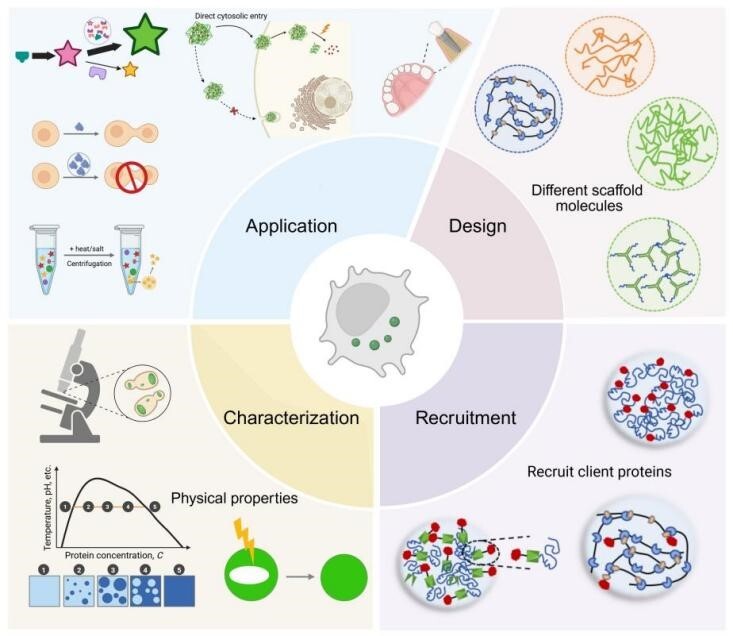
Construction and applications of membraneless organelles (Image by SUN Manman)
<関連情報>
- https://english.cas.cn/newsroom/research-news/202603/t20260310_1152355.shtml
- https://www.sciencedirect.com/science/article/pii/S2405805X26000074
バイオテクノロジーにおける合成相分離膜レス細胞小器官の工学と応用の進歩 Advances in engineering and applications of synthetic phase-separated membraneless organelles in biotechnology
Manman Sun, Alex Xiong Gao, Bin Ye, Yimeng Zhao, Rodrigo Ledesma-Amaro, Jin Gao, Peng Wang
Synthetic and Systems Biotechnology Available online: 22 January 2026
DOI:https://doi.org/10.1016/j.synbio.2026.01.007
Highlights
- Reviews major scaffold types for constructing synthetic membraneless organelles via LLPS.
- Details strategies for client protein recruitment and dynamic control within synthetic organelles.
- Summarizes characterization methods revealing phase behavior and material properties of MLOs.
- Categorizes diverse applications of synthetic MLOs in biotechnology.
- Discusses challenges and future directions for the construction and application of MLOs.
Abstract
Membraneless organelles (MLOs) formed through liquid-liquid phase separation (LLPS) constitute crucial dynamic microenvironments within cells, capable of selectively concentrating specific molecules and regulating biochemical reactions. Based on the working mechanisms of natural MLOs, researchers have designed and constructed various synthetic MLOs. These MLOs have been applied in regulating enzyme activity, optimizing metabolic pathways, regulating gene expression, producing recombinant proteins, and developing functional biomaterials. Here, we systematically summarized the design strategies, characterization techniques, and client protein recruitment methods for synthetic MLOs, and categorically reviewed their application progress in the biotechnology field. We also discussed current challenges faced in the practical applications of synthetic MLOs and future research directions. This review aims to provide theoretical guidance and practical reference for the design and application of LLPS-driven synthetic MLOs, thereby promoting their innovative development in synthetic biology and biotechnology.

