2026-03-18 京都大学
京都大学らの研究チームは、海岸に生息する巻貝(捕食者)と笠貝(被食者)が、移動時に残す粘液の跡を情報として利用し、互いの行動を変化させることを明らかにした。被食者は捕食者に追跡されにくくするため移動パターンを変え、捕食者は粘液跡から獲物の位置や行動を推測するなど、両者の間で「情報戦」が行われている。この成果は、生物が環境中に残す痕跡情報が種間相互作用の形成や維持に重要な役割を果たすことを示し、生態系における新たな相互作用理解の基盤となる。
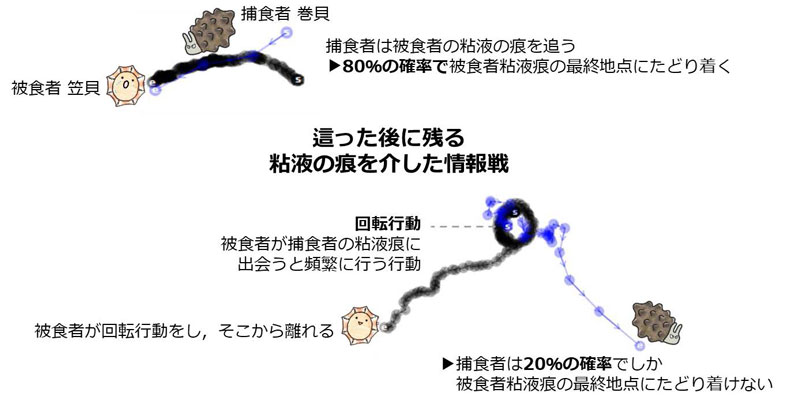
捕食者巻貝と被食者笠貝による粘液跡を用いた情報戦の概要。本図では、黒色が被食者、青色が捕食者の軌道を示す。左上の軌道は被食者が回転行動を行っていない場合、右下の軌道は回転行動を行った場合を示しており、回転行動の有無に応じた移動軌跡と、それに対する捕食者の反応が確認できる。
<関連情報>
- https://www.kyoto-u.ac.jp/ja/research-news/2026-03-18-0
- https://www.kyoto-u.ac.jp/sites/default/files/2026-03/web_2603_Sato-946a81fdc814755027bdc86d7c5688cf.pdf
- https://besjournals.onlinelibrary.wiley.com/doi/10.1111/1365-2656.70235
戦いの軌跡をたどる:捕食者であるカタツムリと被食者であるカサガイの間の情報戦における粘液痕の役割 Tracing the Battle: Role of mucus trails in information warfare between predator snail and prey limpet
Yoko Wada, Takashi Noda, Takashi Y. Ida, Yasushi Iwatani, Takuya Sato
Journal of Animal Ecology Published: 17 March 2026
DOI:https://doi.org/10.1111/1365-2656.70235
Abstract
- Predator–prey interactions have long been recognized as important selective forces in the evolution and maintenance of multiple traits in both predators and prey. Certain animal species leave information intentionally or unintentionally, in the form of urine, faeces, feeding traces and chemical trails, even after they have moved. This residual information, left behind by animals, has the potential to affect predation efficiency. However, information warfare—the use of information between predator and prey, in which predators exploit prey cues to increase predation efficiency, while prey exploit predator cues to reduce it—remains largely unexplored, especially in the context of residual information.
- Marine gastropods leave a mucus trail that contains individual information as they crawl. In this study, we investigated the existence of information warfare between the predator snail Reishia clavigera and the prey limpet Siphonaria sirius through mucus trails. We observed the responses of predators and prey to their respective mucus trails under laboratory conditions.
- The predators followed the prey’s mucus trails. In contrast, the prey exhibited movements, such as looping, upon confrontation with the predator’s mucus trails. The looping behaviour reduced the probability of the predator reaching the endpoint of the prey’s mucus trail.
- These results suggest a potential strategy whereby predators exploit prey mucus trails for localization, along with a counter-strategy through which prey minimize the risk of detection. Our findings provide novel insights into how information shapes predator–prey interactions, indicating the potential existence of an information-induced arms race.