
2026-03-30 カロリンスカ研究所(KI)
<関連情報>
- https://news.ki.se/precision-medicine-helps-more-patients-receive-a-genetic-diagnosis
- https://link.springer.com/article/10.1186/s13073-026-01611-3
カロリンスカ研究所ゲノム医療センターによる希少疾患のゲノムシーケンスに関する10年間の報告書と段階的な臨床導入戦略 The genomic medicine center Karolinska 10-year report on genome sequencing for rare diseases and a strategy for stepwise clinical implementation
Anna Lindstrand,Kristina Lagerstedt-Robinson,Anders Jemt,Malin Kvarnung,Sofia Ygberg,Sofie Vonlanthen,Mikael Oscarson,Daniel Nilsson,Nicole Lesko,Angelo Salazar Mantero,Britt-Marie Anderlid,Henrik Arnell,Cecilia Arthur,Svetlana Bajalica-Lagercrantz,Michela Barbaro,Peter Bergman,Erik Björck,Oda Blomqvist Picard,Helene Bruhn,Jonas Carlsten,Sandrina P. Correia,Karl De Geer,Angelica M. Delgado Vega,Emma Ehn,… Anna Wedell
Genome Medicine Published:30 March 2026
DOI:https://doi.org/10.1186/s13073-026-01611-3
Abstract
Background
As clinical genetics evolves towards the broader field of clinical genomics, the diagnostic approach to rare diseases is undergoing a paradigm shift. This transformation has significantly impacted rare disease diagnostics, increasingly done through gene panels, whole exome and whole genome sequencing. To advance beyond genomics into precision medicine and encompass the breadth of relevant clinical scenarios, a true systems shift is required that challenges conventional barriers and enables the formation of cross-disciplinary, integrated environments.
Methods
The Genomic Medicine Center Karolinska Rare Diseases (GMCK-RD) has, for the past 10 years, brought together healthcare and academia to enable large-scale genome sequencing in a clinical diagnostics context. Within GMCK-RD, experts from various medical disciplines collaborate closely with clinical geneticists, bioinformaticians, and researchers to integrate genome sequencing into healthcare.
Results
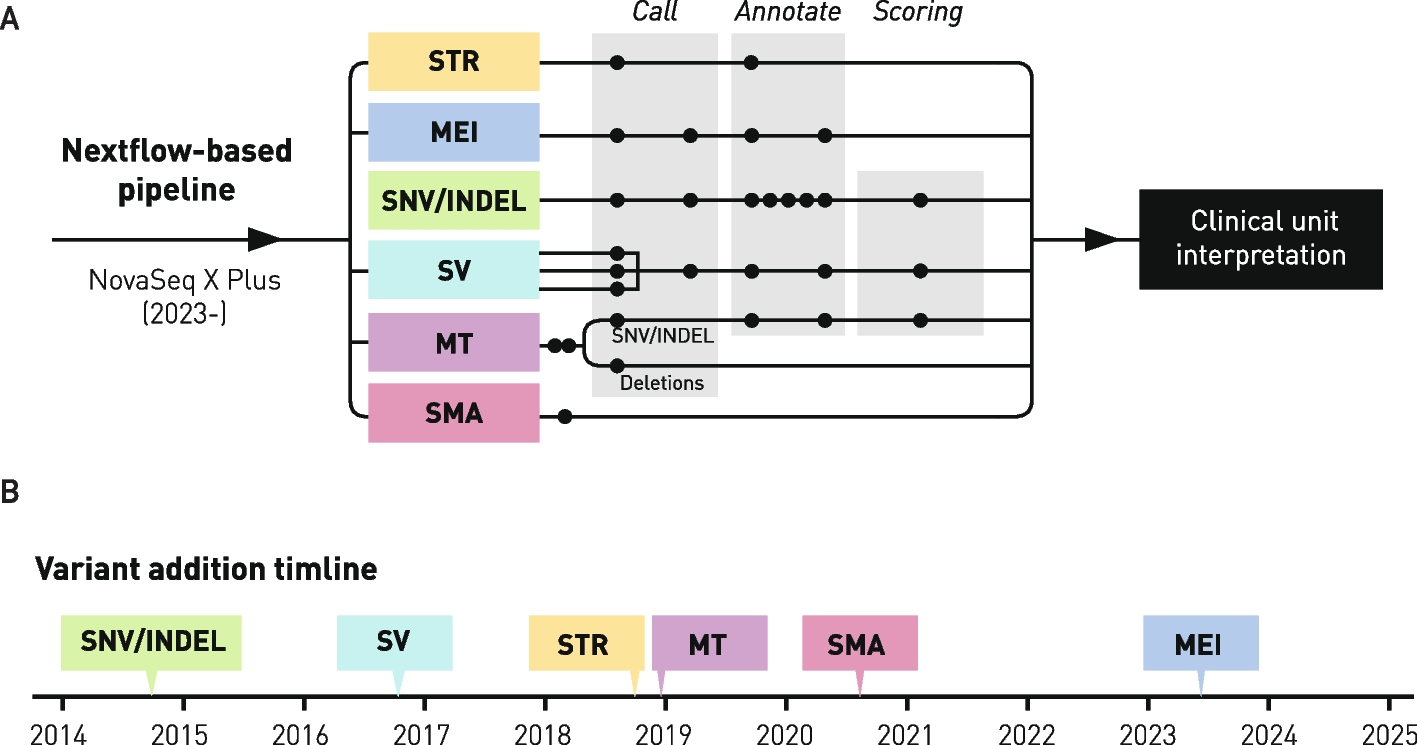
In total, 15 644 individuals with suspected rare diseases were analyzed using clinical genome sequencing, including pediatric (48%), adult (48%) and fetal (4%) samples. The overall diagnostic yield was 22.6%, providing a diagnosis for 3 538 individuals with variants in 1 570 genes. Moreover, a rare disease analysis tool suite developed and validated in house includes a bioinformatic pipeline allowing for comprehensive data analysis covering a wide range of genetic variants including SNVs, INDELs, repeat expansions, uniparental disomies, balanced and unbalanced structural variants as well as insertions of mobile elements. Results are visualized and interpreted in custom-developed decision support systems functioning as an interpretation portal as well as a knowledge-base to capture the interpretation efforts made in a structured format allowing future secondary use.
Conclusions
Altogether, GMCK-RD has shifted healthcare in our region towards precision diagnostics. We emphasize the need to transition from traditional clinical genetic diagnostics to a broader clinical genomics approach. Beyond this shift, we advocate integrating genomics with specialized clinical and laboratory medicine, a concept pioneered for inborn errors of metabolism (IEM) with stepwise spread to additional disease groups. In this model, a multidisciplinary unit combines screening, targeted diagnostics, individualized treatment, and long-term patient follow-up. Here we provide a road map and guide for inspiration for centers aiming to implement genome sequencing in rare disease diagnostics.

