2026-03-31 関西学院大学
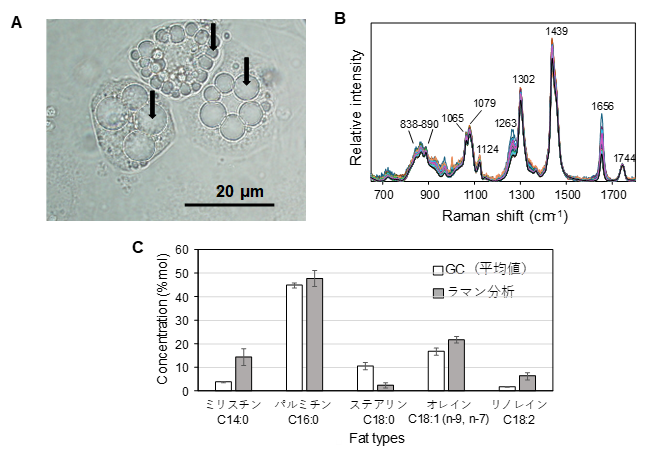
図:脂肪細胞内の脂肪滴の写真(A)と脂肪滴のラマンスペクトル(B)。脂肪滴のラマンスペクトルを開発した定量分析モデルで解析した結果とガスクロマトグラフィー(GC)の結果の比較(C)。GC結果は培養皿全体の細胞の平均値。ラマン分析結果は30細胞の平均値。ラマン分析結果のエラーバーの大きさは、細胞間での濃度の分散を表す。
<関連情報>
生細胞中の脂質滴の脂肪酸組成のラマン分光法に基づく定量分析 Raman Spectroscopy–Based Quantitative Analysis of Fatty Acid Compositions of Lipid Droplets in Live Cells
Pradjna N. Paramitha,Keita Iwasaki,Bibin B. Andriana,Yurika Otoki,Ibuki Kusumoto,Yukihiro Ozaki,Kiyotaka Nakagawa,and Hidetoshi Sato
Analytical Chemistry Published: March 9, 2026
DOI:https://doi.org/10.1021/acs.analchem.5c04227
Abstract
The quantitative analysis of fatty acids (FAs) and their acyl group compositions in triacylglycerols (TAGs) has become one of the main areas of interest for understanding the metabolism and function of fats in the body. Although Raman spectroscopy and chemometric-based analytical methods have previously been applied for directly and nondestructively analyzing fats, fat samples are difficult to quantitatively analyze because an appropriate analytical model must be constructed based on a known calibration data set before applying the model to unknown samples. Therefore, we developed a technique to construct calibration models for fatty acyl groups using simulated TAG spectra generated from fatty acid methyl esters (FAMEs) spectra. Because of the vast diversity of TAGs and high prices of commercial pure reagents, the preparation of accurate concentrations of TAGs for training models would be very difficult and costly. Classical and nonnegative least-squares regressions (CLSR and NNLSR, respectively), which do not require calibration modeling, were compared with analyses using partial least-squares regression (PLSR). A comparative analysis revealed that the combination of PLSR modeling with simulated calibration data sets produced the most accurate predictions. The PLSR models were evaluated using edible oils and, compared to the results obtained using gas chromatography, the models reasonably approximated the fatty acyl group compositions in the fat samples. Then, the models were applied to estimate fatty acyl group compositions in live, single adipocytes. Although the models’ accuracies were limited, they nondestructively estimated the fatty acyl group compositions of LDs in live cells.