2026-03-27 コロンビア大学
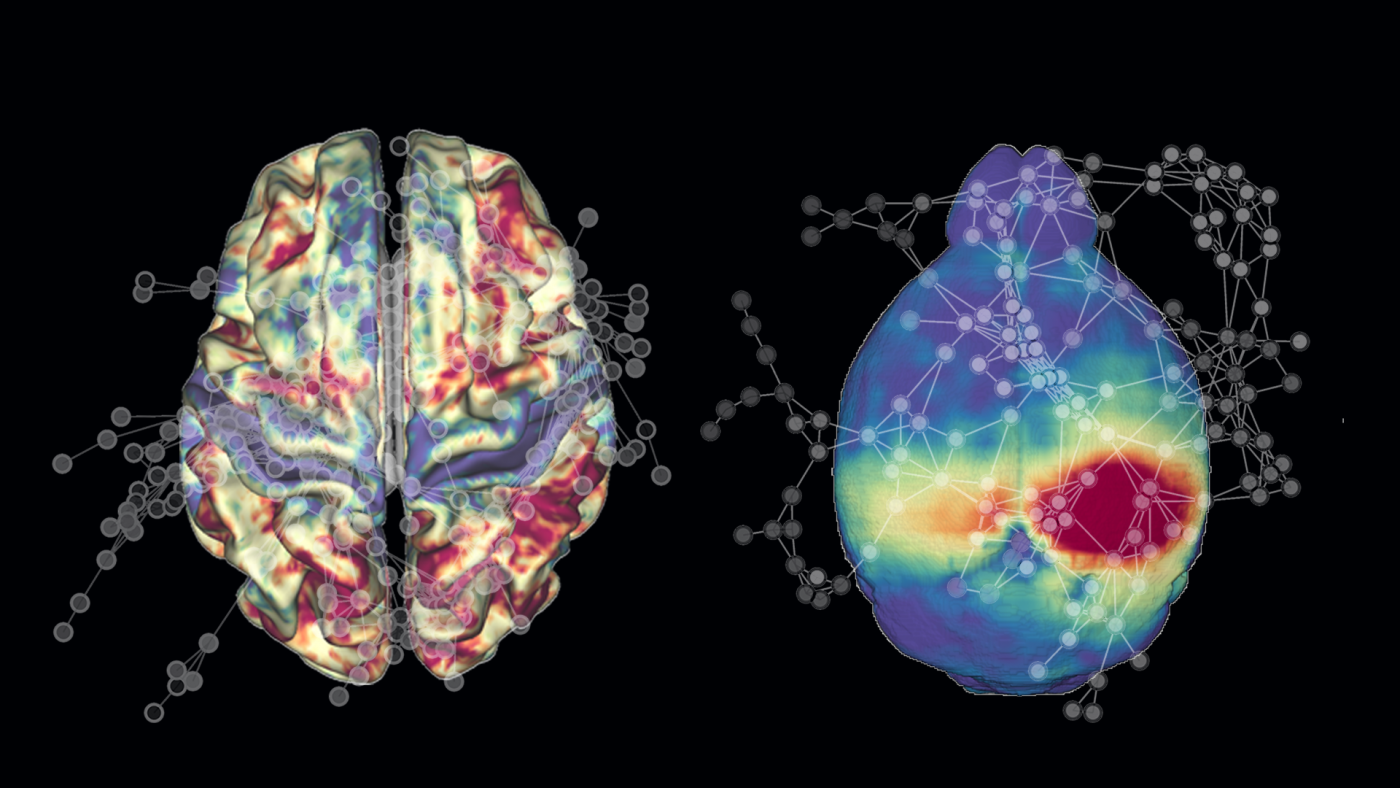
fMRI scans of human (left) and mouse (right) brains revealed patterns of connectivity (circles) that change with age (Credit: Ezra Winter-Nelson)
<関連情報>
- https://zuckermaninstitute.columbia.edu/understand-how-human-brain-ages-science-reveals-new-insights-mice
- https://www.pnas.org/doi/10.1073/pnas.2527522123
- https://www.pnas.org/doi/10.1073/pnas.1415122111
加齢マウスとヒトにおける大規模機能的脳ネットワーク低下の対応関係 Correspondence of large-scale functional brain network decline across aging mice and humans
Ezra Winter-Nelson, Eyal Bergmann, Micaela Y. Chan, +8 , and Gagan S. Wig
Proceedings of the National Academy of Sciences Published:March 27, 2026
DOI:https://doi.org/10.1073/pnas.2527522123
Significance
Human aging is accompanied by changes in large-scale functional brain network organization, which have important consequences for cognition and brain disease. Using awake functional MRI data acquired in mice across a range of adulthood, we demonstrate that aging mice exhibit alterations in brain network organization analogous to those in humans, particularly a loss in functional differentiation. In addition, there exist species-specific differences in network architecture and aging trajectories. These observations establish the mouse as a promising model for investigating the factors that confer resilience and vulnerability to age-related brain network decline and elucidating the cellular and molecular mechanisms of large-scale brain network changes. This meso-scale description of age-related changes in mouse brain networks provides a translational platform bridging species and organizational scales.
Abstract
Human aging is marked by progressive reorganization of large-scale functional brain networks; these brain network changes have been linked to cognitive decline and disease vulnerability. Conversely, while mice have served as powerful models for understanding the molecular and cellular changes that occur over the lifespan, an absence of precise characterization of age-related changes in large-scale functional brain network organization has limited cross-species translational insights. Here, using densely sampled resting-state functional MRI data acquired cross-sectionally and longitudinally in awake mice over a broad range of adulthood (n = 82; 3 to 20 mo), we describe organizational features and age-related alterations of the mouse’s functional connectome. Mouse resting-state functional connectivity recapitulates known functional circuits, demonstrating the organizational validity of these signals. Graph theoretic analysis applied to functional connectivity reveals that mice exhibit modular architectures of functional brain network organization and that increasing age is associated with decreasing system segregation, indicative of network dedifferentiation analogous to observations in humans. Notably, mouse resting-state brain networks are more segregated than those of humans [determined using data from the Human Connectome Project and its developmental- and aging-counterparts (n = 1,179; 18 to 90 y)], attributable to mice exhibiting a diminished contribution of long-range functional relationships that integrate distributed systems. Mice also exhibit slower rates of age-related decline in brain network organization relative to humans, highlighting important species differences in functional brain network organization and trajectories of brain network aging. These findings establish a model of large-scale functional brain network aging in mice and provide a translational bridge across species and spatial scales of analysis.
健康な成人期における脳システムの分離の低下 Decreased segregation of brain systems across the healthy adult lifespan
Micaela Y. Chan, Denise C. Park, Neil K. Savalia, +1 , and Gagan S. Wig
Proceedings of the National Academy of Sciences Published:November 3, 2014
DOI:https://doi.org/10.1073/pnas.1415122111
Significance
The brain is a large-scale network, not unlike many social or technological networks. Just like social networks, brain networks contain subnetworks or systems of highly related or interacting nodes (in the case of brains, nodes may represent neurons or brain areas). Using functional MRI to measure functional correlations between brain areas during periods of rest, we describe differences in brain network organization in a large group of individuals sampled across the healthy adult lifespan (20–89 y). We characterize a measure of system segregation, reflecting the degree to which the systems share connections among one another. Increasing age is accompanied by decreasing segregation of brain systems. Importantly, system segregation is predictive of measures of long-term memory function, independent of age.
Abstract
Healthy aging has been associated with decreased specialization in brain function. This characterization has focused largely on describing age-accompanied differences in specialization at the level of neurons and brain areas. We expand this work to describe systems-level differences in specialization in a healthy adult lifespan sample (n = 210; 20–89 y). A graph-theoretic framework is used to guide analysis of functional MRI resting-state data and describe systems-level differences in connectivity of individual brain networks. Young adults’ brain systems exhibit a balance of within- and between-system correlations that is characteristic of segregated and specialized organization. Increasing age is accompanied by decreasing segregation of brain systems. Compared with systems involved in the processing of sensory input and motor output, systems mediating “associative” operations exhibit a distinct pattern of reductions in segregation across the adult lifespan. Of particular importance, the magnitude of association system segregation is predictive of long-term memory function, independent of an individual’s age.