2026-04-02 北海道大学
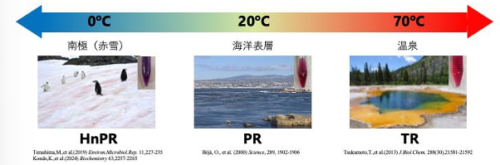
図1. 本研究で解析した、低温(南極)、中温(海洋表層)、高温(温泉)の各温度環境に分布する3種類のプロトンポンプ型ロドプシン。(左、Hymenobacter nivis P3T 由来 proteorhodopsin(HnPR);中央、γ-Proteobacteria SAR86 由来 proteorhodopsin(PR);右、Thermus thermophilus JL-18 由来 thermophilic rhodopsin(TR))
<関連情報>
- https://www.hokudai.ac.jp/news/2026/04/post-2241.html
- https://www.hokudai.ac.jp/news/pdf/260402_pr3.pdf
- https://pubs.acs.org/doi/10.1021/acs.biochem.6c00052
多様な温度環境に分布す る3種類の外向きプロトンポンプ型ロドプシンの温度適応を支える熱力学的基盤 Thermodynamic Basis of Temperature Adaptation in Three Outward Proton Pump Rhodopsins Distributed Across Diverse Thermal Environments
Ryouhei Ohtake,Kaori Kondo,Shunsuke Nakano,Makoto Demura,Takashi Kikukawa,and Takashi Tsukamoto
Biochemistry Published: March 31, 2026
DOI:https://doi.org/10.1021/acs.biochem.6c00052
Abstract
Microbial rhodopsins with light-driven outward proton pump activity are widely distributed across Earth’s diverse environments and contribute to solar energy conversion in global ecosystems. Yet, the thermodynamic principles enabling their function across broad temperature ranges remain poorly understood. Here, we examined the photocycles of three outward proton pump rhodopsins originating from low-, moderate-, and high-temperature environments─HnPR, PR, and TR─and analyzed their kinetics over a wide temperature range using flash photolysis. Thermodynamic activation parameters were determined for each transition state based on transition-state theory. Comparative analysis revealed that the balance of enthalpic and entropic contributions in the early P1 → P2 transition strongly correlates with the environmental temperature in which each rhodopsin is distributed, reflecting distinct adaptation strategies among the three proteins. TR exhibited temperature-dependent alterations in its photocycle, including a shift in the linearity of the Eyring plot for the P2 → P3 transition, consistent with a structural rearrangement previously observed by time-resolved FTIR spectroscopy. In contrast, HnPR displayed hallmark features of cold-adapted proteins in the P4 → P0 transition, including a reduced activation enthalpy and a pronounced decrease in activation entropy, enabling efficient turnover at low temperatures. Together, these findings provide a thermodynamic framework for understanding how outward proton pump rhodopsins function across diverse thermal habitats and illustrate the distinct molecular strategies by which they balance functional dynamics and structural stability to support light-driven proton transport in nature.