2026-04-09 東京農業大学
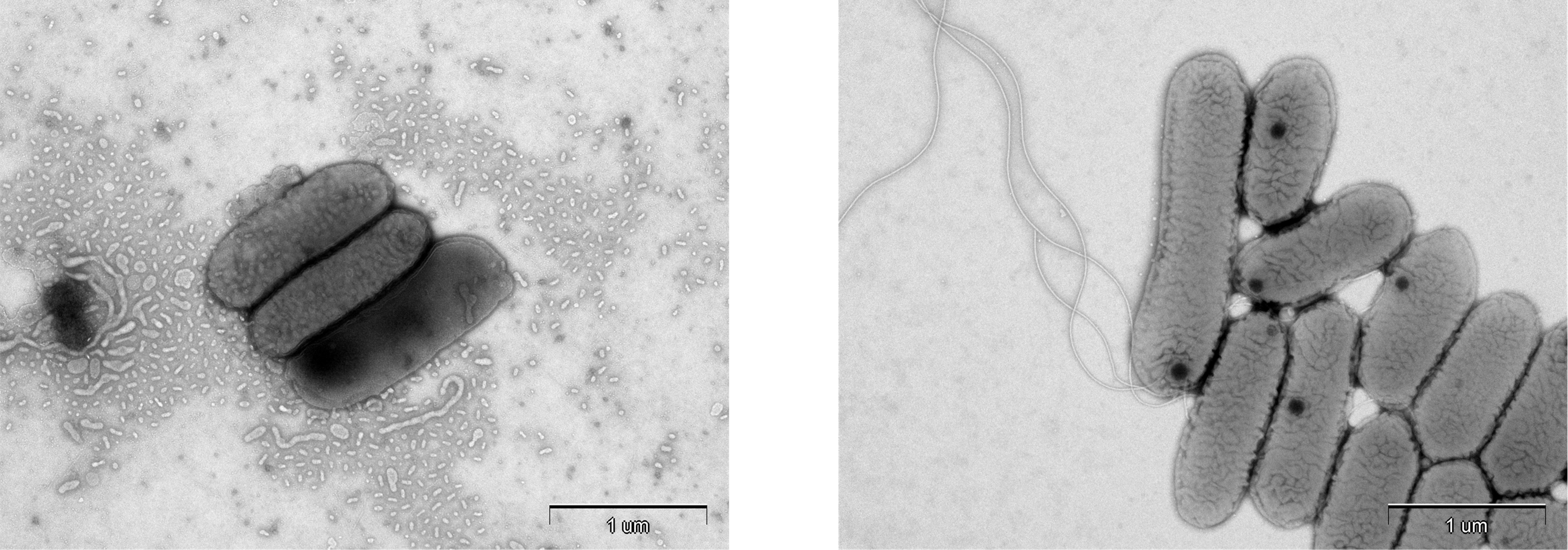
図2. 塩生植物シバナから単離された新種細菌の電子顕微鏡写真
(左) Qipengyuania triglochinis (右) Alteriqipengyuania triglochinis
<関連情報>
- https://www.nodai.ac.jp/news/article/2-36/
- https://www.microbiologyresearch.org/content/journal/ijsem/10.1099/ijsem.0.007113
Qipengyuania triglochinis sp. nov. およびAlteriqipengyuania triglochinis sp. nov.: Triglochin maritima L. の根圏および根から分離された2 つの新規Erythrobacteraceaeメンバー Qipengyuania triglochinis sp. nov. and Alteriqipengyuania triglochinis sp. nov.: two novel Erythrobacteraceae members isolated from rhizosphere and root in Triglochin maritima L.
Kosuke Yamamoto, Fumiya Watanabe, Riku Murakami, Hinako Kubo, Takao Iino, Moriya Ohkuma, Minenosuke Matsutani, Hikaru Sakamoto, Hiromasa Saitoh and Naoto Tanaka
International Journal of Systematic and Evolutionary Microbiology Published: 02 April 2026
DOI:https://doi.org/10.1099/ijsem.0.007113
Abstract
Two novel bacterial strains, designated as strains 483ᵀ and 357ᵀ, were isolated from the rhizosphere and root, respectively, of Triglochin maritima L. collected from Lake Notoro, Hokkaido, Japan. Strain 357ᵀ was motile, whereas strain 483ᵀ was non-motile. Both strains grew at 10–40 °C (optimum, 30 °C), pH 5.5–9.0 (optimum, pH 6.0) and 0–15.94% (w/v) NaCl (optimum, 1.94%). Based on 16S rRNA gene sequences, strain 483ᵀ was most similar to Qipengyuania aestuarii GH1ᵀ (99.7%), while strain 357ᵀ was closely related to Alteriqipengyuania abyssalis NZ-12Bᵀ and Alteriqipengyuania lutimaris S-5ᵀ (both 98.7%). Phylogenetic analysis based on 16S rRNA gene sequences revealed that strains 483ᵀ and 357ᵀ clustered with Q. aestuarii GH1ᵀ and A. abyssalis NZ-12Bᵀ, respectively. Whole-genome phylogeny showed consistent results. DNA G+C contents were 59.9 mol% (strain 483ᵀ) and 65.4 mol% (strain 357ᵀ). The average nucleotide identity (ANI), fastANI and digital DNA–DNA hybridization values between the novel strains and their closest relatives were 82.8–85.5%, 82.8–85.5% and 25.2–26.3%, respectively. Both strains contained ubiquinone-10 as the sole respiratory quinone. The major fatty acids in strain 483ᵀ were C14 : 0 2-OH and summed feature 8 (C18 : 1 ω7c), differing from Q. aestuarii. In strain 357ᵀ, C17 : 1 ω6c and summed feature 8 predominated, similar to A. abyssalis and A. lutimaris. Polar lipids of strain 483ᵀ were mainly phosphatidylcholine, phosphatidylethanolamine, phosphatidylglycerol, diphosphatidylglycerol, sphingoglycolipid and five unidentified lipids, whereas strain 357ᵀ mainly contained phosphatidylcholine, phosphatidylglycerol, diphosphatidylglycerol, sphingoglycolipid and three unidentified lipids. Based on these results, strains 483ᵀ and 357ᵀ represent novel species of Qipengyuania and Alteriqipengyuania, for which the names Qipengyuania triglochinis sp. nov. and Alteriqipengyuania triglochinis sp. nov. are proposed. The type strains are strain 483ᵀ (=NRIC 2006ᵀ=JCM 36263ᵀ=NCIMB 15619ᵀ=DSM 120134T) and strain 357ᵀ (=NRIC 2005ᵀ=JCM 36262ᵀ=NCIMB 15618ᵀ=DSM 120133T).