2026-04-30 コンコルディア大学

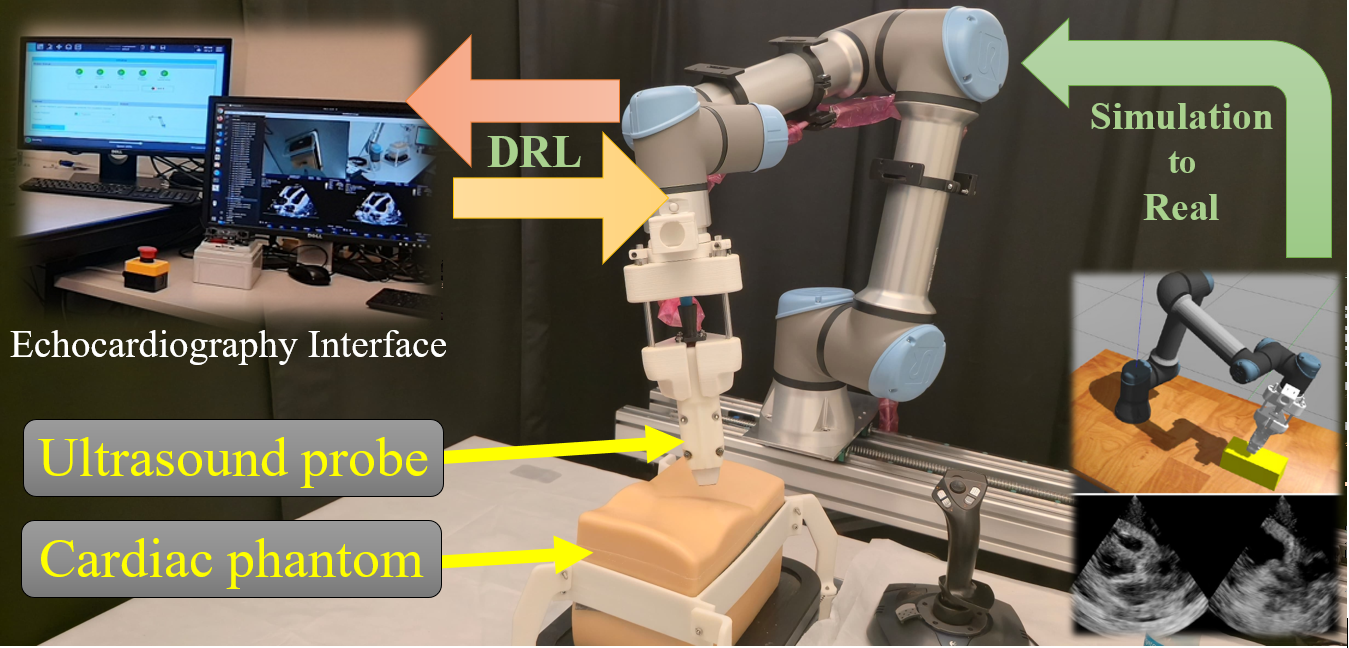
Model illustration by Ehsan Zakeri
<関連情報>
- https://www.concordia.ca/cunews/ginacody/2026/04/30/new-ai-powered-robotic-system-performs-heart-ultrasounds-without-guidance.html?c=/research/news
- https://ieeexplore.ieee.org/document/11311134
深層強化学習に基づく自律型ロボット心エコー検査のための超音波画像サーボ制御方式 Deep Reinforcement Learning-Based Ultrasound Visual Servoing Scheme for Autonomous Robotic Echocardiography
Ehsan Zakeri; Amanda Spilkin; Hanae Elmekki; Antonela Zanuttini; Wen-Fang Xie; Lyes Kadem,…
IEEE Transactions on Medical Robotics and Bionics Published:22 December 2025
DOI:https://doi.org/10.1109/TMRB.2025.3646715
Abstract:
This study develops a deep reinforcement learning (DRL)-based ultrasound visual servoing (DBUVS) scheme for an autonomous robotic echocardiography system. The proposed approach aims to replace remote cardiac sonographers with a newly developed AI agent, Cardiac Sonographer Net (CS-Net), trained using DRL based on the Soft Actor-Critic (SAC) algorithm. To train CS-Net, a robotic echocardiography environment is simulated in GAZEBO simulator using a two-stage generative AI (GenAI) approach to produce high-fidelity synthetic ultrasound images. In the first stage, multiple convolutional neural networks (CNNs) generate initial ultrasound images based on different parameter settings from a given probe pose. A fuzzy inference system (FIS) then fuses these images into a single low-quality representation. In the second stage, a super-resolution generative adversarial network with gradient penalty (SRGAN-GP) enhances image quality. Compared with low-quality images, the GenAI-based outputs show an 11.37% improvement in learned perceptual image patch similarity (LPIPS) and higher resolution ( 256×256 to 500×500 pixels), closely matching real ultrasound images. CS-Net is initially trained in the simulation environment and deployed on the real experimental robotic system with an ultrasound probe mounted on the end effector and a cardiac phantom for testing, using sim-to-real transfer learning. Experimental results demonstrate that the robotic echocardiography system powered by CS-Net performs autonomous scanning with higher accuracy and efficiency than the echocardiography remotely operated by the sonographer. Specifically, the system achieves faster convergence by reaching an image feature error norm of 0.176 in 25 seconds, compared with 0.253 in 50 seconds for remote operation.