2026-05-04 シンガポール国立大学(NUS)
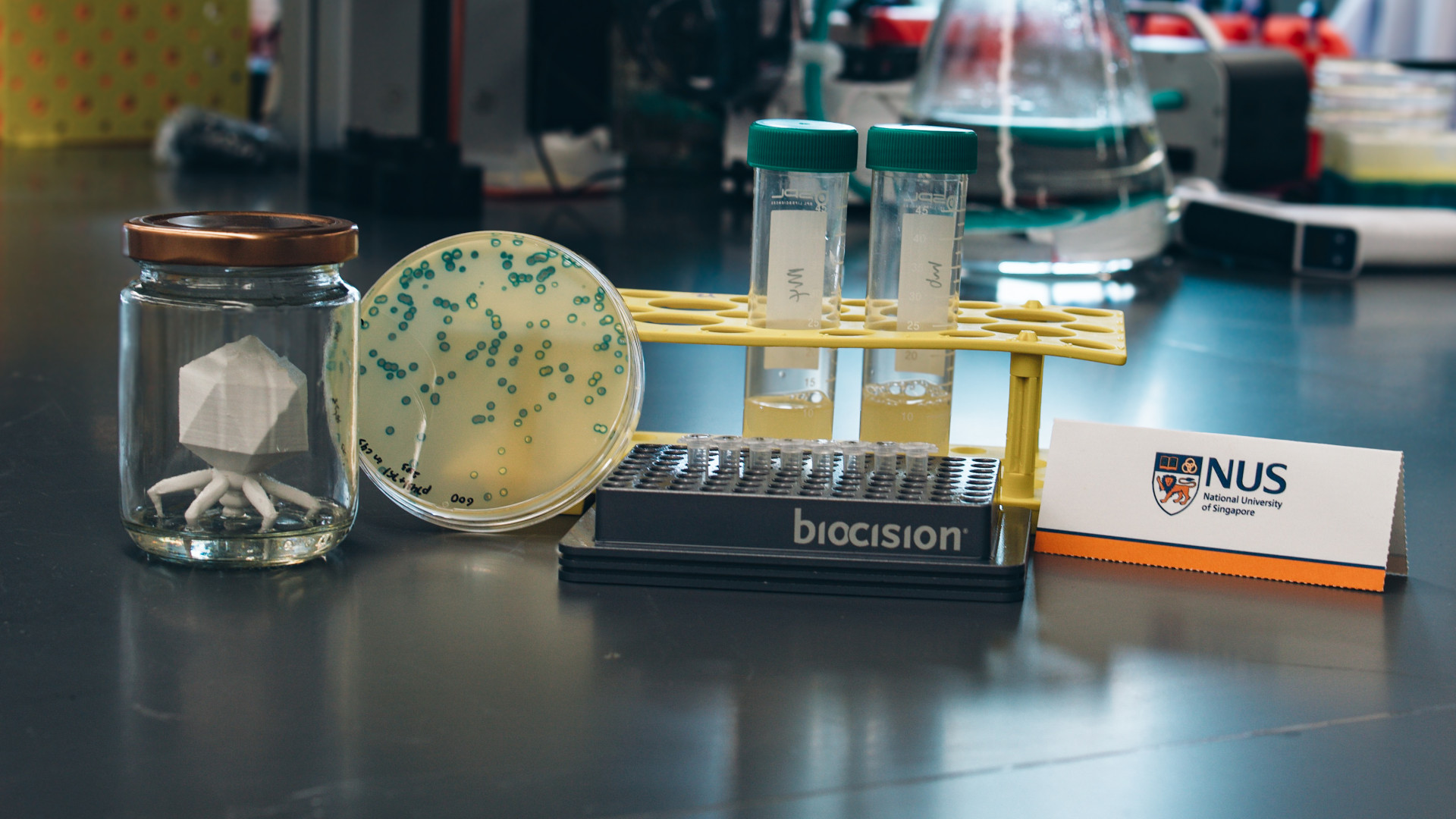
E. coli cultures and other experimental materials used in the study, shown with a 3D-printed model of the engineered phage (extreme left).
<関連情報>
- https://news.nus.edu.sg/scientists-train-bacteria-munching-plastics/
- https://www.nature.com/articles/s41564-026-02346-y
制御可能な超変異誘発性ファージ・細菌システムによる連続的進化と離散的進化の橋渡し Bridging continuous and discrete evolution through a controllable, hypermutagenic phage-bacteria system
Shujian Ong,Pramila Ghode,Ashvinath Narenderan,Shuxuan Lao,Fabian Willenborg,Tobias V. Eden,Carl O. Marsh,Wen Shan Yew & Julius Fredens
Nature Microbiology Published:01 May 2026
DOI:https://doi.org/10.1038/s41564-026-02346-y
Abstract
Directed evolution methods face trade-offs between the control of discrete approaches and the throughput of modern continuous systems. Here, we engineered a method called lytic selection and evolution (LySE) for near-continuous evolution of bacterial gene clusters while maintaining discrete checkpoints. We developed a hypermutagenic T7 DNA polymerase variant fused to a dual adenine-cytosine deaminase to install all possible transition mutations at similar frequencies. By relieving pressure from maintaining genome fidelity, we obtained mutation rates of 3.82 × 10⁻⁵ substitutions per base. For biocontainment, the T7 DNA polymerase was encoded on an accessory plasmid, while the target gene cluster was encoded on a T7 DNA polymerase-lacking T7 phagemid. Alternating cycles of lysis and transduction enable selective replication and mutagenesis of target genes, while off-target genomic mutations are discarded. LySE evolved a 25-fold increase in tetA-encoded tigecycline resistance in 5 cycles, and a 50.9% increase in endpoint biomass of a bacterial strain that uses the polyethylene terephthalate monomer, ethylene glycol, as its sole carbon source. Our method balances speed and control for directed bacterial evolution.