2026-05-20 北京大学(PKU)
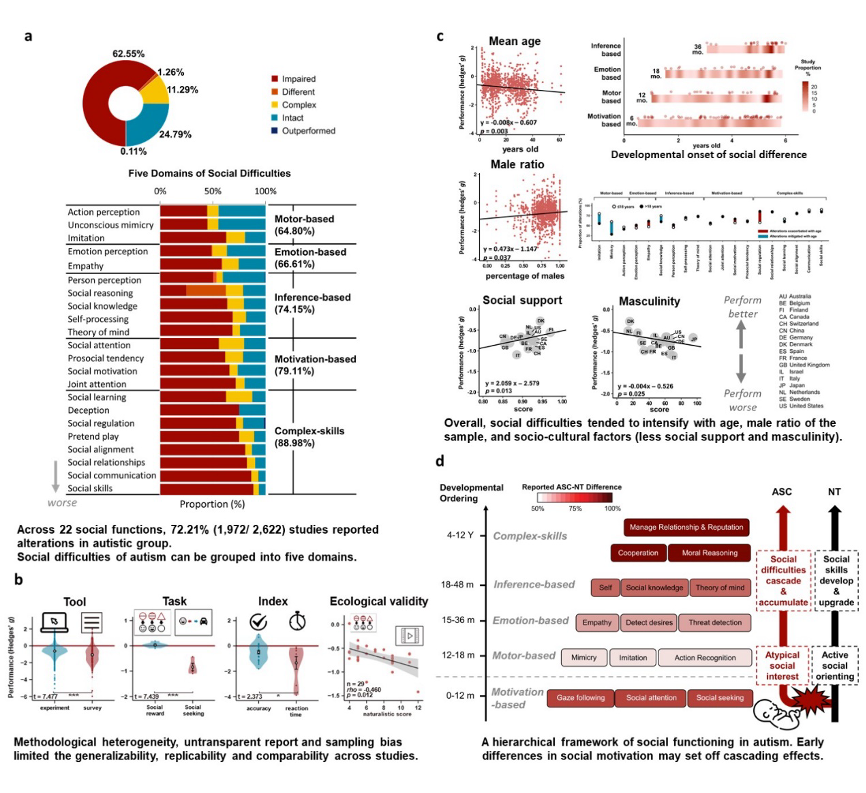
Patterns of Social Functioning Differences in Autism.
<関連情報>
- https://newsen.pku.edu.cn/news_events/news/research/15533.html
- https://www.nature.com/articles/s41562-026-02457-w
自閉症における社会的機能:系統的レビューとメタ分析 Social functioning in autism: a systematic review and meta-analysis
Siyi Li,Huanqing Wang,Guoqiu Chen,Xi Cheng,Yuxi Wang,Wanyan Hu,Antonia Hamilton,Leonhard Schilbach,Li Yi,Kaat Alaerts,Zhanjun Zhang,Xi-Nian Zuo,Yin Wang & Yinyin Zang
Nature Human Behaviour Published:12 May 2026
DOI:https://doi.org/10.1038/s41562-026-02457-w
Abstract
Atypical social functioning is a core feature of autism, yet findings remain fragmented across components and development. We aimed to systematically integrate this literature and characterize the organization, development and moderators of social functioning in autism. We conducted a systematic review and meta-analysis of behavioural studies published between January 1990 and August 2025, identified through PubMed, Web of Science and prior reviews, including studies with clinically diagnosed autistic individuals and neurotypical controls. A qualitative synthesis and two complementary quantitative meta-analyses were performed, with risk of bias evaluated through study-level characteristics. A total of 2,622 studies (94,114 autistic and 172,847 neurotypical individuals across 32 countries) were included, covering 22 social components that clustered into five domains. Overall group differences were substantial (Hedges’ g = −0.744; 95% confidence interval, (−0.797, −0.690)). Differences emerged the earliest in motivation-based processes (around six months), followed by motor, emotion and inference domains, and showed age-related divergence alongside improvement in some skills. Cross-domain analyses revealed stronger interdependencies in autism and an organizational pattern most consistent with serial relationships among domains. These findings should be interpreted in the light of methodological heterogeneity, underpowered samples and uneven cultural representation. Together, the results provide an integrative framework for understanding the organization and development of social functioning in autism, with implications for precision subtyping, developmentally timed interventions and neurodiversity-informed research and policy.