2026-08-17 ローレンス・バークレー国立研究所(LBNL)
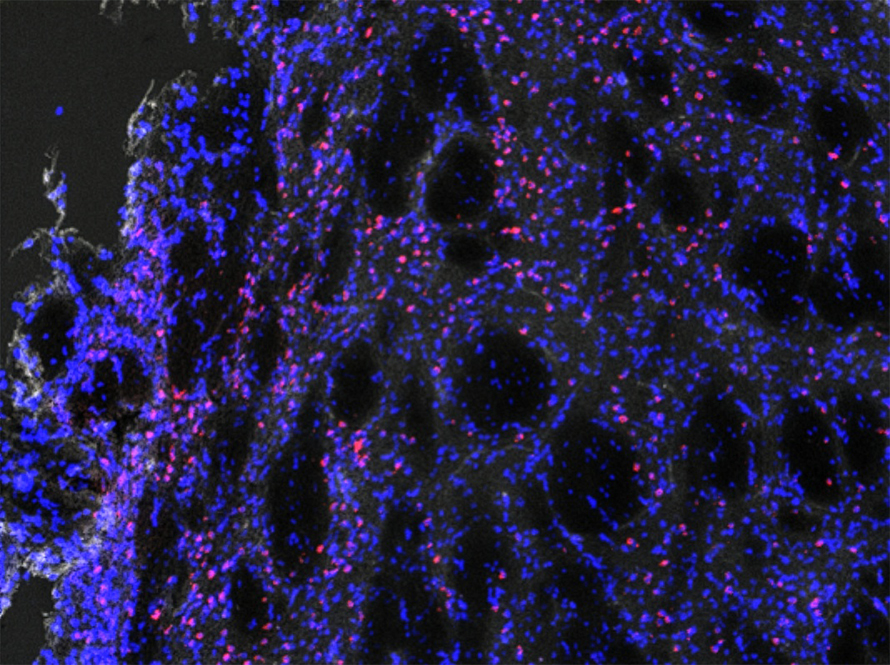
This super-resolution fluorescence microscopy image shows tissue from the striatum region of the brain from a HD mouse model. The red spots indicate the presence of broken DNA strands, which leads to the hallmark symptoms of HD and eventually death. (Credit: Aris Polyzos/Berkeley Lab)
<関連情報>
- https://newscenter.lbl.gov/2026/08/17/huntingtons-disease-discovery-opens-door-to-a-new-class-of-treatments/
- https://www.nature.com/articles/s41467-026-72382-z
二本鎖切断は、体細胞増殖の有無にかかわらず、ハンチントン病マウスモデルにおける毒性を引き起こす Double strand breaks drive toxicity in a Huntington’s disease mouse model with or without somatic expansion
Aris A. Polyzos,Ana Cheong,Jung Hyun Yoo,Lana Blagec,Zachary D. Nagel & Cynthia T. McMurray
Nature Communications Published:06 May 2026
DOI:https://doi.org/10.1038/s41467-026-72382-z
Abstract
Genome-wide association studies (GWAS) have provided strong evidence that modifiers of CAG tract length have a crucial influence on Huntington disease onset, but somatic expansion alone may not be sufficient to drive neuronal death. Here, we report that DSBs drive neuropathology in male HdhQ(150/150) mice, regardless of somatic expansion of the inherited disease allele. DSBs and somatic expansion occur simultaneously in the HD brain, but the two types of DNA damage drive disease by distinct mechanisms. The site-specific increases in CAG tract length are driven by active mismatch repair (MMR), while DSBs occur genome-wide and are driven by mutant huntingtin-mediated suppression of nonhomologous joining of DNA broken ends. DSBs and transcriptional dysfunction occur in animals that cannot somatically expand their inherited allele. Conversely, suppression of DSBs is sufficient to reverse neuropathology even when somatic expansion is active. We propose that CAG expansion and DSBs promote downstream neuronal pathology as separable drivers. The disease-length CAG tract leads to early inhibition of DSBR and accumulating DSBs over time ultimately kill neurons.