2026-08-14 ワシントン大学セントルイス校
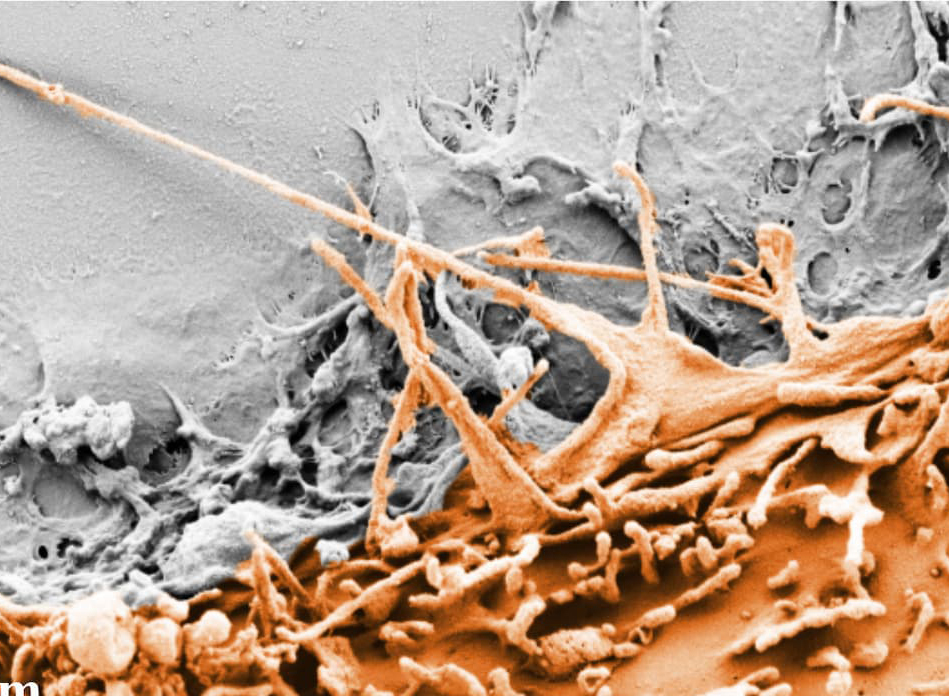
Pictured is a scanning electron microscopy (SEM) image of human mammary epithelial MCF10A cells (orange) sensing a laser-ablated micro-defect on a collagen type I extracellular matrix surface through filopodial protrusions. (Image: Hannah Zmuda, with support from the Washington University Cellular Imaging Center)
<関連情報>
- https://source.washu.edu/2026/08/tiny-feet-on-cells-sense-defects-stall-migration-to-heal-wounds/
- https://www.cell.com/cell-reports/fulltext/S2211-1247(26)00832-6
微細なマトリックス欠陥は、張力依存性の突起形成を抑制し、細胞の集団移動を阻害する Microscale matrix defects suppress tension-dependent protrusions and stall collective cell migration
Hannah Zmuda ∙ Diego Barra Avila ∙ Ping-Hsien Lee ∙ Christopher Walter ∙ Amit Pathak
Cell Reports Published:July 31, 2026
DOI:https://doi.org/10.1016/j.celrep.2026.117754
Highlights
- Microscale defects on collagen-IV surfaces stall epithelial migration
- Leader filopodia sense defects; cytoskeletal disruption propagates to followers
- Collagen-I or stiffer substrates boost protrusions and prevent migratory stalling
- Hypotonic media enhances membrane tension, softens cells, and reduces stalling
Summary
During development, wound repair, and disease, epithelia must detect and respond to subtle extracellular defects to maintain coordinated migration. We show that collectively migrating epithelia undergo large-scale spatiotemporal stalling in response to laser-ablated micro-defects in the presence of collagen type IV. When the filopodia of leading-edge cells encounter micro-defects, the resulting local cytoskeletal disruption propagates to the follower cells, producing multicellular stalling over length scales much larger than the original defect. Extracellular changes in matrix stiffness, collagen type, and osmolarity regulate cell stiffness and membrane tension, which, in turn, control protrusive activity and stall migration. Through these extracellular variations, we found that stiffer cells and lower membrane tension suppress protrusions in leader cells, which enhances multicellular stalling through intercellular propagation of cytoskeletal disruption. This work advances the biophysical understanding of cell migration by showing that collagen-IV, softer matrices, and hypertonic media enhance cellular sensing of extracellular defects and wounds.