2026-06-12 京都大学
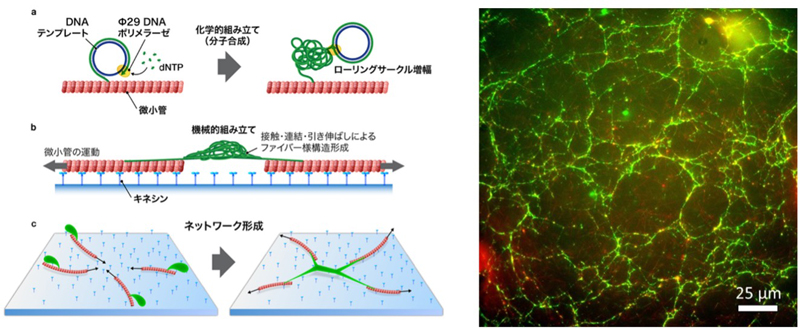
2種類の生体分子ナノマシンによるDNAネットワークの動的形成(論文より)
<関連情報>
- https://www.kyoto-u.ac.jp/ja/research-news/2026-06-12-1
- https://onlinelibrary.wiley.com/doi/10.1002/smll.202514262
生体分子ナノマシンによるDNAネットワークのボトムアップ合成と能動的アセンブリ Bottom-Up Synthesis and Active Assembly of DNA Networks by Biomolecular Nanomachines
Farhana Afroze, Richard J Archer, Mahammad Mustakim, Rakesh Das, Arif Md. Rashedul Kabir, Yuuto Miura, Rubaya Rashid, Kazuki Sada, Tetsuya Hiraiwa, Shin-ichiro M. Nomura, Shogo Hamada, Akira Kakugo
Small Published: 11 June 2026
DOI:https://doi.org/10.1002/smll.202514262
ABSTRACT
Active assembly of matter is a defining trait of living systems, enabling the creation of far-from-equilibrium materials essential for the functionality of life. This is achieved through energy-dissipative, multi-step processes facilitated by biomolecular nanomachines performing bottom-up chemical and mechanical assembly of matter. Mimicking such active assembly synthetically remains a challenge. Here, a bio-inspired bottom-up strategy for energy-dissipative material assembly, driven by biomolecular nanomachines and overcoming thermodynamic and diffusive constraints, is demonstrated. Specifically, two chemically-fueled biomolecular nanomachines—DNA polymerase and kinesin—are used to demonstrate a multi-step chemical synthesis and mechanical manipulation process. This results in a DNA biopolymer network with complex hierarchical morphologies unattainable by self-assembly alone. DNA polymerase generates DNA, which forms a fibrous 2D-network when actively connected and pulled between kinesin-powered motile microtubules. Experimental data and simulations show that both DNA-DNA interactions and active mechanical forces from molecular motors are essential to this process. Furthermore, key factors for network formation are investigated by systematically investigating DNA polymerase incubation time and microtubule density. The present work provides a key step toward bottom-up fabrication of complex and dynamic materials by mimicking the sophisticated assembly strategies of living systems, potentially providing a framework for future materials assembled by nanomachines.