2026-06-15 スイス連邦工科大学ローザンヌ校(EPFL)
◆従来のDBSは一定条件で刺激を与える方式が主流であったが、歩行時の状態変化や症状の揺らぎに十分対応できなかった。本技術では、脳活動や身体運動の情報をAIが継続的に解析し、患者の歩行リズムや運動状態に合わせて刺激強度やタイミングを瞬時に最適化する。これにより、歩行の停止(フリージング)やバランス障害を効果的に抑制し、より自然で安定した歩行を実現できる可能性が示された。
◆研究成果は、神経刺激治療を固定的な制御から適応型・個別化医療へ進化させるものであり、将来的にはパーキンソン病以外の神経疾患への応用も期待される。さらに、AIと神経工学を融合した次世代ブレイン・コンピュータ技術の発展にも重要な一歩となる。
<関連情報>
- https://actu.epfl.ch/news/when-brain-stimulation-learns-to-walk-with-you/
- https://www.nature.com/articles/s41591-026-04432-4
活動依存型適応深部脳刺激はパーキンソン病患者の歩行を改善する Activity-dependent adaptive deep brain stimulation improves gait in Parkinson’s disease
Stefano Scafa,Valeria de Seta,Ruijia Wang,Paula Sánchez López,Andrea Sánchez López,Camille Varescon,Icare Sakr,Nadia Bérard,Lea Bole-Feysot,Céline Deschenaux,Ian Enderli,Yohann Thenaisie,Morgane Burri,Frédéric Merlos,Vanessa Fleury,Benoit Wicki,Ettore Accolla,Andria Tziakouri,Cécile Hübsch,Mayte Castro Jiménez,Julien F. Bally,Alessandro Puiatti,Kyuhwa Lee,Henri Lorach,… Eduardo M. Moraud
Nature Medicine Published:15 June 2026
DOI:https://doi.org/10.1038/s41591-026-04432-4
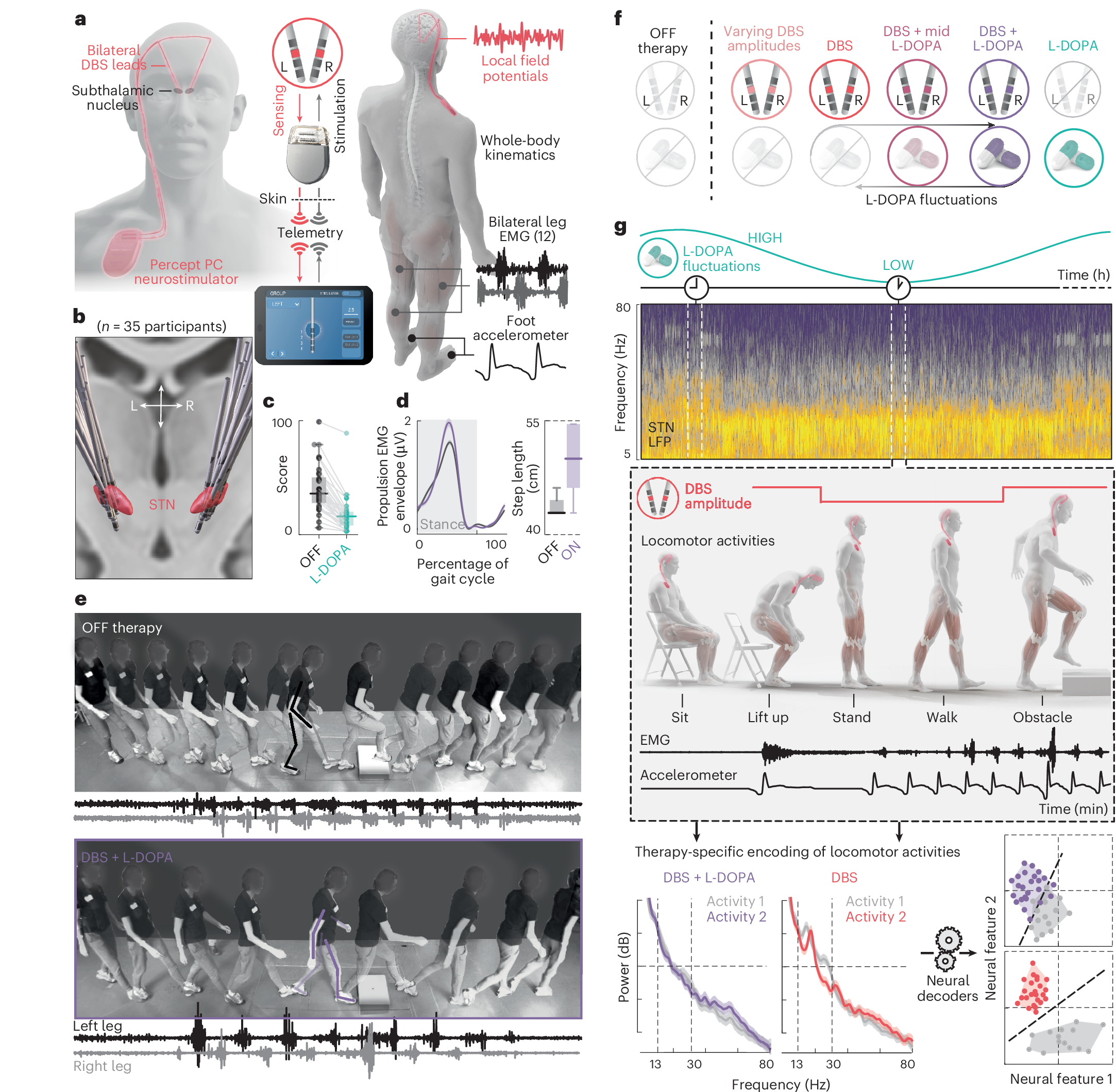
Abstract
Parkinson’s disease leads to a spectrum of locomotor deficits that vary in severity with the nature of daily activities and the fluctuating physiology of patients. Many of these deficits remain inadequately addressed by existing deep brain stimulation therapies that rely on activity-agnostic parameters optimized for cardinal motor symptoms. By contrast, therapies embedding activity-specific parameters have the potential to better address the entire range of symptoms. Here we expose physiological principles that enable real-time decoding of ongoing locomotor activities across motor fluctuations from the neural dynamics of the subthalamic nucleus. This decoding steered activity-dependent adaptations of deep brain stimulation therapies that improved locomotor deficits while preserving efficacy for cardinal motor symptoms across activities of daily living. Our activity-dependent framework provides a blueprint for next-generation neuromodulation therapies that continuously select parameters optimized to the behavioral context and fluctuating physiology of each patient. ClinicalTrials.gov registration NCT06791902.