2026-05-15 京都大学
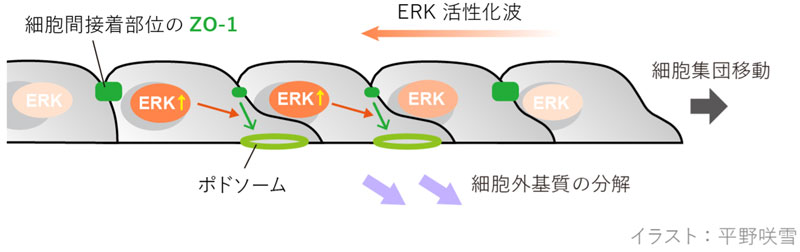
細胞集団移動におけるZO-1の動的局在変化のイメージ図。ERK活性化の波が細胞集団内を伝わり、細胞間接着部位に存在するZO-1が細胞底面のポドソームへ一時的に移動する。ポドソームに集積したZO-1は、細胞外基質への力の発生や基質分解を促し、細胞の浸潤的な移動を調整する。
<関連情報>
- https://www.kyoto-u.ac.jp/ja/research-news/2026-05-15-1
- https://www.nature.com/articles/s41467-026-72840-8
ZO-1はERK活性化波に乗って頂端接着複合体とポドソームの間を移動する ZO-1 shuttles between apical junctional complexes and podosomes by riding ERK activation waves
Sayuki Hirano,Yohei Kondo,Asayuki Kitajima,Noriyuki Kinoshita,Tetsuhisa Otani,Mikio Furuse,Naoto Ueno & Kazuhiro Aoki
Nature Communications Published:09 May 2026
DOI:https://doi.org/10.1038/s41467-026-72840-8 Unedited version
Abstract
Collective cell migration is essential in various physiological processes, including embryonic development, wound healing, and cancer metastasis. However, the mechanisms by which individual cells achieve coordinated movement remain elusive. Here, we demonstrate that zonula occludens-1 (ZO-1), a scaffolding protein of tight junctions (TJs), dynamically translocates to form cell–extracellular matrix (ECM) adhesion complexes, podosomes, at the basal cell surface during migration. Extracellular signal-regulated kinase (ERK) activation triggers the translocation of ZO-1 to podosomes, where ZO-1 promotes invasive migration. ZO-1 also contributes to ERK activation dynamics within the cell collective, thereby influencing collective migratory behavior. In this work, we elucidate the dual roles of ZO-1 in coordinating intercellular signaling and invasive movement, providing insights into the mechanisms that integrate individual cell behaviors into a cohesive collective migration.