2026-06-08 東京科学大学
◆研究では、宿主胚に存在する原始マクロファージが、生きた異種ドナー細胞を認識して貪食・排除する現象を「ゼノファゴサイトーシス(異種食細胞作用)」と命名した。異種環境下でドナー細胞はストレスにより細胞表面へホスファチジルセリン(Eat-meシグナル)を露出し、これを宿主マクロファージのAxl受容体が認識することで排除が誘導されることを解明した。さらに研究チームは、マクロファージ除去、CD47(Don’t eat meシグナル)の導入、ATP11C活性強化によるホスファチジルセリン露出抑制という回避戦略を開発し、異種細胞の生着率を大幅に向上させた。ラット→マウスでの膵臓形成効率が改善し、ヒト→マウス系でもヒト細胞の生存率向上が確認された。本成果は、将来的なブタ体内でのヒト臓器作製や移植医療への応用に向けた重要な基盤技術となる。
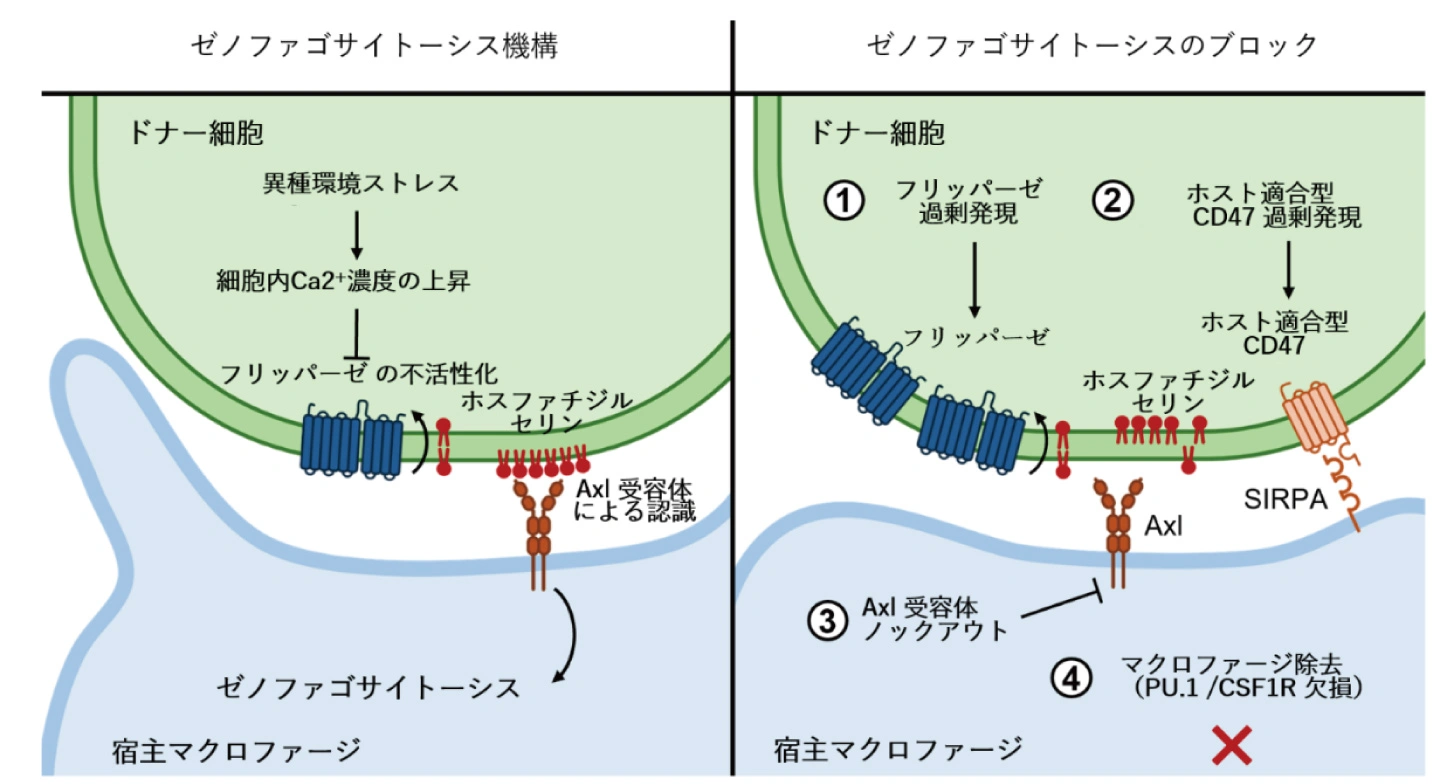
図1. 異種胚盤胞補完における「ゼノファゴサイトーシス」と、その回避戦略の模式図。宿主マクロファージが異種ドナー細胞を排除する仕組みと、CD47導入やATP11C強化、マクロファージ除去などによる回避法を示している。
<関連情報>
- https://www.isct.ac.jp/ja/news/dgopuh0iikpr#top
- https://www.cell.com/cell/abstract/S0092-8674(26)00575-1
異種食作用阻害は異種間キメラ形成を促進する Xenophagocytosis blockade enhances interspecies chimerism
Sicong Wang ∙ Kouta Niizuma ∙ Daniel Dan Liu ∙ … ∙ Jinyu Zhang ∙ Irving L. Weissman ∙ Hiromitsu Nakauchi
Cell Published:June 5, 2026
DOI:https://doi.org/10.1016/j.cell.2026.05.016
Highlights
- Xenophagocytosis mediated by primitive macrophages restricts interspecies chimerism
- Elevated phosphatidylserine on donor cells drives Axl-mediated macrophage clearance
- Macrophage ablation and donor CD47/ATP11C flippase overexpression block xenophagocytosis
- Xenophagocytosis blockade enables high-level rat-mouse chimerism and pancreas formation
Summary
Organ shortage remains a major challenge in transplantation medicine. Interspecies blastocyst complementation offers a promising strategy to generate human organs in livestock. However, efficient xenogeneic donor cell engraftment remains challenging. Here, we identify an innate immune barrier wherein host macrophages selectively eliminate viable xenogeneic donor cells, a process we term xenophagocytosis. Mechanistically, xenogeneic cells display elevated phosphatidylserine, an “eat-me” signal recognized by host macrophages through phagocytic receptor Axl. We demonstrate three orthogonal strategies for xenophagocytosis blockade: genetic ablation of macrophages or the Axl receptor in the host embryo or overexpression of the “don’t-eat-me” signal CD47 or the phosphatidylserine-regulating flippase ATP11C in donor cells. Xenophagocytosis blockade enhances rat and human donor chimerism in mouse embryos and improves interspecies pancreas complementation efficiency. These findings reveal a previously unrecognized innate immune barrier that safeguards species integrity during early embryogenesis and provide mechanistic insights to enhance xenogeneic chimerism for generating human organs in livestock.